



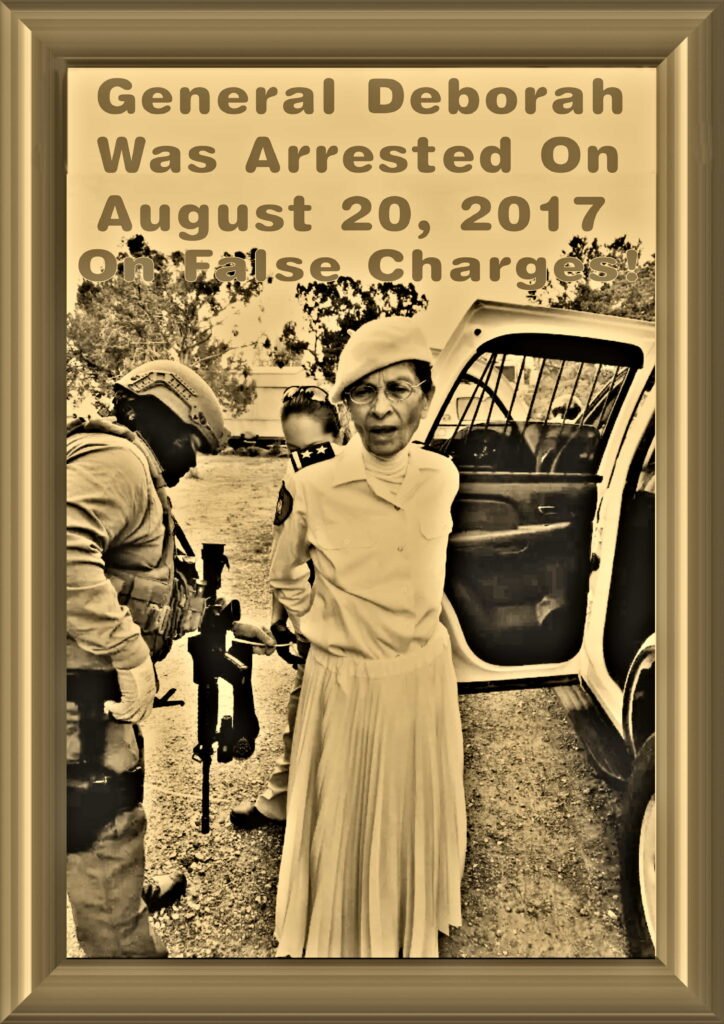
On January 28, 2022, General Deborah Green was released from prison. She is happy to be back with her people and very thankful to the Lord for keeping her safe through that long and arduous test. God is still blessing her (and us) with a steady stream of Prophetic Words of the Spirit. She wants to thank everyone for their prayers. Following is a copy of the request for a new trial which was the tool God used to secure Deborah’s release.The enemy will always accuse God’s people. And God will stand with them through it all.
In The Interest Of Justice:
MOTION FOR A NEW TRIAL BECAUSE OF NEWLY DISCOVERED EVIDENCE
Defendant Deborah Green respectfully requests, according to rule 5-614, NMRA, a new trial in this matter because of the discovery of new evidence not previously disclosed by the State. All of this evidence, which the State failed to disclose through discovery before the trial in this matter, constitutes new evidence that can form the basis for a new trial. Because such evidence is exculpatory, and essential to any jury’s consideration of the allegations against Mrs. Green, this motion should be granted, the jury verdict and sentence in this matter should be vacated, and Mrs. Green should be awarded a new trial.
Factual Background
Deborah Green was charged, by an amended indictment, with two counts of kidnapping in the First Degree, two counts of Abuse of a Child (Does Not Result in Death or Great Bodily Harm), two counts of Abuse of a Child Resulting in Great Bodily Harm, three counts of Criminal Sexual Penetration in the First Degree (Child Under 13), one count of Abuse of a Child Resulting in Death, two counts of Tampering with Evidence (Capital Crime or First of Second Degree Felony), and one count of Tampering with Evidence (Third or Fourth Degree Felony). The first eight counts allege crimes against alleged victim M.G., while the remaining five counts allege crimes against victim E.M. The Court later severed the charges for the purpose of trial, ordering that the counts related to alleged victim M.G. be tried first. All eight of the counts regarding M.G. Include some allegation connected to the sexual abuse of M.G.
A trial for the Counts related to alleged victim M.G. Was held from September 18, 2018 through September 26, 2018. Following trial, the jury returned a verdict of guilty on all counts. Mrs. Green was then sentenced to seventy-two years of incarceration in the New Mexico Corrections Department. She then pled no contest to three of the remaining charges against her, receiving an additional sentence of ten years to run concurrent with the previously imposed seventy-two year sentence.
Since trial, Counsel for Mrs. Green has uncovered, or been alerted to, the existence of exculpatory evidence not previously disclosed by the State. This previously undisclosed evidence includes:
1. A 2006 psychological assessment of M.G. Performed by Dr. Carol Larroque wherein Dr. Larroque concluded that M.G. Showed no signs psychologically of being traumatized or depressed and denied abuse. While the State had previously disclosed a summary of Dr. Larroque’s evaluation, the State failed to seek or actually disclose any records related to the actual exam. The medical records related to this examination are currently undergoing in camera review before Judge Villalobos in State v. Peter Green, No. D-1333-CR-2017-00262.
2. A second SANE exam of M.G. during which M.G. denied abuse. During this exam, M.G. received an examination in her genital area. The SANE exam uncovered no signs of sexual abuse.
3. Medical records related to M.G.’s hospitalization at Children’s Psychiatric Hospital when she first began to disclose abuse. This disclosure was made after M.G. Was living with a foster family for several months, which included a primary caretaker that suffered from bi-polar disorder, and who was arrested after threatening to kill himself, unplugging the phone when his wife tried to call 911, battering a police officer, and using his car to block the driveway so his wife and foster children could not leave the residence.
4. A safehouse interview of M.G., conducted on August 25, 2006, during which M.G. Denied abuse after being questioned by Dr. Larroque and undergoing a full SANE exam of her genitals.
Ms. Green now files this motion, seeking a new trial on counts One through Eight of the Amended Indictment because of this new evidence.
Argument
A motion for a new trial under Rule 5-614 must meet six criteria: 1) the new evidence will probably change the result if a new trial is granted; 2) the evidence must have been discovered since the trial; 3) the new evidence could not have been discovered before the trial by the exercise of due diligence; 4) the new evidence must be material; 5) the new evidence must not be merely cumulative; and 6) the new evidence must not be used merely for impeachment or contradiction. See State v. Volpato, 1985-NMSC-017, ¶ 7, 102 N.M. 383, 969 p.2d 471; State v. Fero, 1988-NMSC-053, ¶ 13, 107 N.M. 369, 758 P.2d 783. The evidence discovered since the trial in this matter fulfills every prong of this analysis. Ms. Green’s motion should be granted, and the Court should order a new trial for all charges related to M.G.
I. This motion is timely filed.
As a threshold matter, this motion is timely filed under Rule 5-614, NMRA. That rule requires such a motion to be filed before a final judgment or within two years after the entry of a final judgment. Rule 5-614(C), NMRA. Rule 516 does not define when there is a final judgment, and there is a split of authority regarding when a judgment becomes final for the purposes of this rule. Some cases imply that a judgment is final upon sentencing. See State v. Moreland, 2007-NMCA-047, ¶ 13, 141 N.M. 549, 157 P.3d 728 (explaining, the context of reviewing a rule 5-614(C) motion, that “[i]t is well settled that until a sentence for a crime is imposed, there is no final judgment in a criminal case.”) (internal citation omitted). In contrast, federal authority counsels, in the context of mtions for new trials under the corresponding Federal Rule of Criminal Procedure, that there is no final judgment until all direct appeals are exhausted. See, e.g., Casias v. United States, 33 F.3d 354, 356 (10th Cir. 1964) (holding that, in context of a motion for a new trial because of newly discovered evidence, a judgment is not final until the time to take an appeal has expired or all appeals are complete). Ms. Green’s motion is timely under either test.
Ms. Green was convicted on September 26, 2018 and was sentenced on October 16, 2018. Moreover, Ms. Green’s former counsel never filed a notice of appeal or a waiver of appeal for this matter. Therefore, under Moreland, Ms. Green’s motion is timely because it is filed within two years of sentencing, and under Casias, the motion is timely because Ms. Green has yet to file an appeal, and still possesses a right to file a direct appeal. Ms. Green’s motion is timely and should be considered on its merits.
II. All six Volpato factors are present, mandating that the court exercise its discretion and order a new trial in this matter.
Applying the Volpato factors to the new evidence present through this motion militates in favor of a new trial. First, Ms. Green must establish that the new evidence would probably change the result of the previous trial. In this case, Ms. Green puts forward a motion which details several pieces of new evidence, all of which are exculpatory to the allegations that she sexually abused M.G. Specifically, the new evidence contains one new SANE examination which concluded there was no evidence of abuse, which is clearly exculpatory when the allegation is that Ms. Green sexually abused M.G. by penetrating M.G. with sticks, screwdrivers, and needles. There is simply no possibility that M.G. Could have been penetrated in that matter and there was no evidence of abuse. Moreover, the evidence also includes psychological records establishing that M.G. Showed no symptoms of trauma or sexual abuse. And the evidence also includes safehouse interviews, during which M.G. Stated that she was not sexually abused, or that it was another individual and not Ms. Green that sexually abused her. All of this evidence is exculpatory and supports Ms. Green’s defense that she did not sexually abuse M.G. Therefore, there is a probability that the evidence would have changed the result of a trial.
For example,in United States v. Martinez, 388 F. Supp. 3D 225, 232 (E.D.N.Y. 2019), a prison guard was charged with and convicted of sexual abuse. The evidence presented at trial was not “considerable forensic [or] other physical evidence,” but was instead based “primarily on the perceptions” of witnesses. Following trial, the defense uncovered an interview with a witness that did not testify, and which was not turned over during discovery, during which the witness testified that the alleged victim in that case discussed having sex with a prison guard in great detail but never stated that she was assaulted or abused. Explaining that “[c]ontradictory evidence can destroy a jury’s confidence in a witness’s story,” the trial court determined that there was a liklihood of a different outcome at the trial. Id. This conclusion was further bolstered by the fact that the undisclosed, exculpatory statement offered “‘independent corroboration of the defense’s theory of the case by a neutral and disinterested witness.'” Id. (quoting Boss v. Pierce, 263 F.3d 734,745 (7th Cir. 2001)).
The same is true in this case. The newly discovered evidence presents independent corroboration that Ms. Green did not sexually abuse M.G. and presents that evidence from neutral and disinterested witnesses. The first Volpato factor, therefore, counsels in favor of a new trial. Moreover, because exculpatory information, like the newly discovered evidence in this case, could affect the outcome of the trial, it is material, and meets the materiality requirement of Volpato. See United States v. Bagley, 473 U.S. 667, 678 (1985) (defining “material” exculpatory evidence as evidence that would “undermine the confidence in the outcome of a trial”). See also United States v. Coppa, 267 F.3d 132, 146 (2d Cir. 2001) (holding that “material required to be disclosed by Brady . . . is material, which, if not disclosed, creates a reasonable probability of altering the outcome” of a trial).
The newly discovered evidence also meets the second prong, because the proffered evidence was never disclosed during discovery in this case and was only discovered after Ms. Green was convicted, sentenced, and pled no contest to additional charges. The fifth Volpato factor is also fulfilled in this case because this evidence is not cumulative because it contains a previously undisclosed SANE exam, previously unknown safehouse interviews, and a newly discovered psychological examination concluding that M.G. was not a victim of sexual abuse for the time period that she was in Ms. Green’s custody. Finally, the sixth factor is also me because the evidence is not merely impeaching or contradictory but represents new evidence from neutral witnesses that M.G. was not sexually abused as alleged by the State. See Volpato, 1985-NMSC-017, at ¶¶ 9-11 (holding that evidence through the form of new testimony is not merely contradictory when that testimony corroborates the defense’s story because a defendant should have the right to have all of the testimony submitted to a jury in order that the jury might then determine guilt or innocence).
This motion also fulfills the Volpato factor requiring that the newly discovered evidence could not have been discovered before the first trial with the exercise of diligence. The New Mexico Courts have applied a relatively lax standard when determining whether defense counsel exercised due diligence. For example, the Supreme Court has held that there was no exercise of due diligence when the newly discovered evidence was related to information which the defendant possessed before the trial. See State v. Mabry, 1981-NMSC-067, ¶ 29, 96 N.M. 317, 630 P.2d 269 (explaining that due diligence requires the investigation of prior knowledge otherwise “a [motion for a] new trial would subject ever criminal trial to the possibility of reopening on the ground that the defendant ‘remembered’ something after trial”). Here, while there is limited prior knowledge regarding the second SANE exam and the psychological records, the State represented to the defense and to the court that those records were lost or not obtainable. Moreover, all of the examinations detailed in the new evidence were conducted after M.G. was removed by CYFD and was in the custody of a foster family. Therefore, neither the defense nor Ms. Green had any knowledge that such records existed before her initial trial.
Moreover, the Supreme Court has held that due diligence requires a defendant to conduct an investigation “to discover witnesses [or evidence] that would tend to exculpate an accused.” State v. Stephens, 1982-NMSC-128, ¶ 12, 99 N.M. 32, 653 P.2d 863. For example, the New Mexico Courts have found that there was not sufficient due diligence when an allegedly exculpatory recantation was referenced in a nolle prosequi that was previously filed in the case. State v. Miera, 2018-NMCA-020, ¶ 28, 413 p.3D 491. Similarly, the Court of Appeals of New Mexico found that new evidence failed the due diligence prong when it was identified and available for copying prior to trial. State v. Armijo, 1997-NMCA-080, ¶ 35, 123 N.M. 690, 944 P2d 919. And, the Supreme Court of New Mexico has held that results of post-trial diagnostic testing were acquired following due diligence during trial when the basis for the testing was not apparent before trial. State v. Moreland, 2008-NMSC-021, at ¶¶ 18-21.
No such circumstance is present in this case. An investigation was conducted in this case, with interviews of dozens of witnesses and thousands of pages of discovery disclosed. None of those interviews or records disclosed available copies of the previous SANE exam, safehouse interviews, or psychological evaluations related to whether M.G. had been sexually abused. Nor did the State identify for the defense that such evidence existed. In fact, no witness list of the State identified the medical professionals involved in the SANE or psychological exams, nor did any witness list identify the individuals that performed the undisclosed safehouse interviews. Therefore, Ms. Green exercised due diligence during the trial. The motion for a new trial because of newly discovered evidence should be granted.
III. Defendant is entitled to a new trial because the failure to disclose the new evidence violates Brady v. Maryland.
Brady v. Maryland imposes upon the State the obligation to reveal evidence within its possession that is material to the guilt of the accused. 373 U.S. 83, 87 (1963). To obtain a new trial based on a Brady claim of newly discovered evidence, the defendant must show that: “(1) the government possessed favorable evidence to the defendant; (2) the defendant does not possess the evidence and could not obtain the evidence with any reasonable diligence; (3) the prosecution suppressed the favorable evidence; and (4) had the evidence been disclosed to the defendant, there is a reasonable probability that the outcome would have been different.” United States v. Vallejo, 297 F.3d 1154, 1164 (11th Cir. 2002). A “reasonable probability” is “a probability sufficient to undermine confidence in the outcome.” United States v. Bagley, 473 U.S. 667, 672 (1985).
The new evidence uncovered in this case meets that test. First, as discussed in greater detail above, Ms. Green did not possess evidence related to the second SANE exam prior to trial. That SANE exam was also mentioned for the first time during trial, therefore, Ms. Green could not have accessed that SANE exam with reasonable diligence. Moreover, the evidence was possessed by the State because it was in the possession of the Cibola County Sheriff’s office and produced to counsel for Peter Green in State v. Green by that office. Finally, it was suppressed because it was never disclosed to the defense, and because the State has continuously asserted that any records related to the second SANE exam were lost. That, however, was untrue.
Because the second SANE exam is exculpatory and confirms the defense’s theory at the initial trial, then there is a reasonable probability that the evidence would undermine confidence in the outcome of the first trial. Therefore, separate from any analysis of the Volpato factors, the Court should also grant the motion for a new trial because the State failed to meed its obligations under Brady.
IV. The Court should Exercise Its Discretion to Grant a New Trial Because a New Trial is Required in the Interest of Justice.
“Because the trial judge has observed the demeanor of the witnesses and has heard all the evidence, . . . the function of passing on motions for new trial belongs naturally and peculiarly to the trial court.” State v. Smith, 1986-NMSC-038, ¶ 17, 104 N.M. 329, 721 P.2d 397. This is especially so when the evidence is reliable and tends to show the actual evidence of a defendant. See Montoya v. Ulibarri, 2007-NMSC-035, ¶ 32, 142 N.M. 89, 163 P.3d 476. Therefore, the Court should exercise such discretion, specifically granted to the court by Rule 5-614, and order a new trial in this case as required in the interest of justice. Rule 5-614 (A) (stating that when a defendant has been found guilty, the court on its own motion may grant a new trial, “if required in the interest of justice”). The newly discovered evidence in this motion is evidence that should have been disclosed by the State during discovery prior to Ms. Green’s trial. See Rule 5-501(A)(3), NMRA (requiring the disclosure of any records “which are material to the preparation of the defense”) and Rule 5-501 (A)(4), NMRA (requiring the disclosure of “any results or reports of physical or mental examinations . . . made in connection with the particular case”). The failure to disclose such evidence violates the State’s Brady obligation to disclose exculpatory evidence. See Copa, 267 F.3d at 146 (holding that Brady requires the disclosure of exculpatory evidence “in time for its effective use at trial or at a plea proceeding”). It is therefore in the interests of justice to order a new trial in this matter. See e.g., United States v. Cestoni, 185 F. Supp. 3D 1184, 1195-96 (holding that the prosecution’s Brady violations can be the basis of granting a new trial in the interest of justice).
Conclusion
The Court should grant the motion for a new trial, vacate the jury verdict for this matter, vacate the sentence imposed on Ms. Green, and order a new trial on all charges.
Respectfully submitted,
Carter B. Harrison IV
Nicholas T. Hart
Harrison & Hart, LLC
1001 Luna Circle NW
ABQ, NM 87102
505.295.3261
harrisonhartlaw.com
Counsel for Deborah Green

The Smell of Hell!
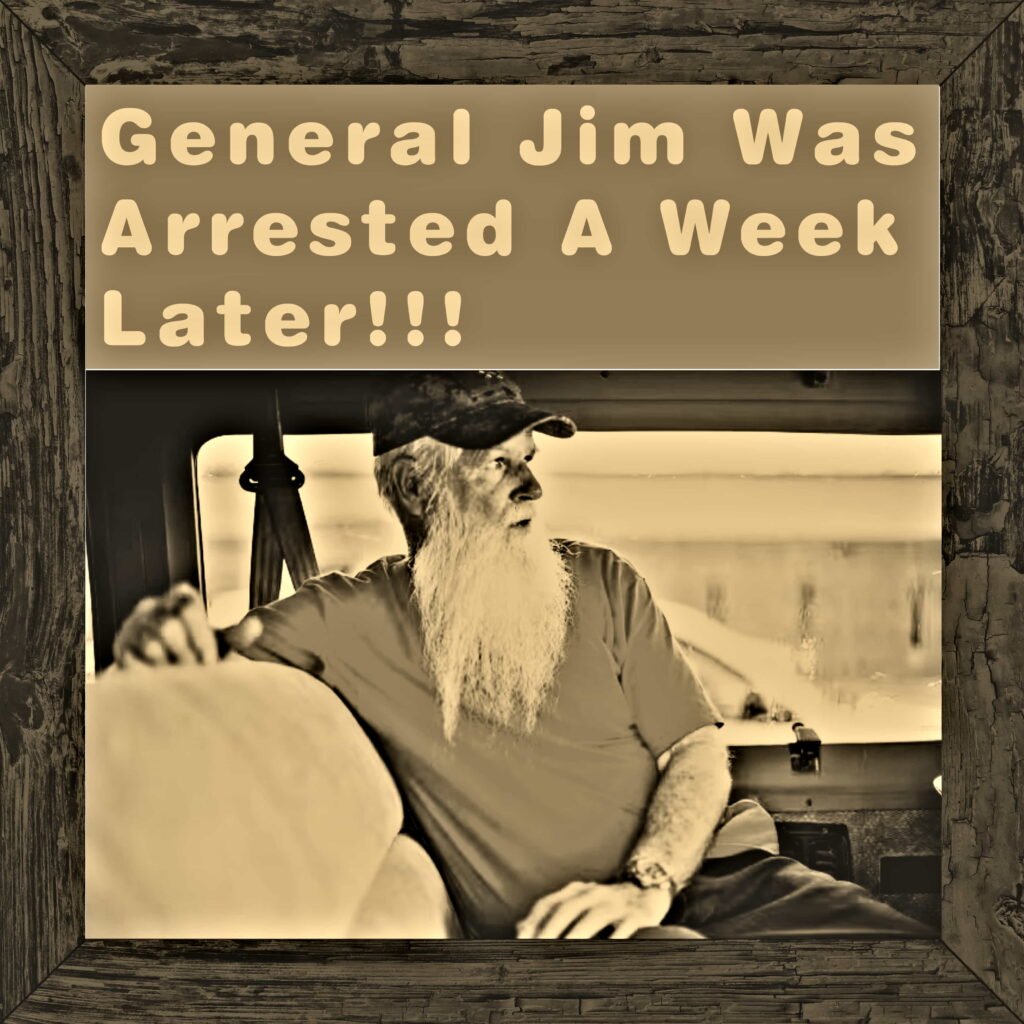
By: Gen. Jim – 5/27/26
Profile of Character Assassins
As I read “The Oracle’s Daughter” the smell of Hell emits from its pages. Hill actually believes passionately the things he writes. The EX-ACMTC members Hill quotes (in his interviews) have one thing in common: they all without exception play the part of “victim” – victims of a “dark, dangerous cult” led by General Deborah Lila Green & her husband Gen. Jim, infamous for BRAINWASHING. Yep, that would be us!
But…
Before we started ACMTC we spent months in Bible studies showing what was expected of God’s true followers. We let those in attendance decide if they wanted to be missionaries, not mere church-goers. Some had come out of various churches. Some were new to Christianity. After months of Bible study the day came when we presented the people who had been part of Free Love Ministries (God’s love was & is free – Jn. 3:16 –) to sign a pledge that they understood & were willing to “Take Jesus to All the World”! We discussed uniforms – symbolic of “Soldiering for Christ” (1 Tim. 1:18; 2 Tim. 2:3 etc.). We told the group that the Salvation Army had adopted the uniform & rank system back in the 1800s, & that we had worked with the SA in Miami, Fla. We told them that we would have an “open door” policy meaning, you came in as a volunteer, on your own free will; if you decide you can’t take the training you are free to go back out the same door you came in. This was our policy – still is. All this “they held me captive” BS is just that. BS!
Recruitment
Yes, we did recruit. Is this evil? We offered more then most churches offered, to be personally involved, not merely a person – in – the pew paying tithes, listening to a dry sermon Sunday after Sunday (some came to us from those who kept Saturday as holy day). We would be a “Life Force”/“Eagle Force” that rescued souls from Satan’s captivity. Is this evil?
While we got into uniform – all agreed – fasted/prayed for souls around us & around the world, we did not go unnoticed. Oh, no, all HELL broke out against us. The media began to portray us as a militant CULT/SECT that brainwashed, even punished, abused. Well, these accusations brought on more troubles, police investigations (read our PX2 Files). Hill writes about all this. But he is not fair, why should he be, seeing his book was/is designed to SLANDER/ACCUSE us.
The Truth Was/Is…
There are some who neglect the calling cause they refuse to face the trying of their faith. In the formulative stage of ACMTC, we taught hundreds of messages – from the Bible – no one could say Deborah or myself deceived the people – we have most of those teachings & preachings preserved (Battle Cry Pubs./Videos/Cassettes. This was before DVD/CD became available. When they did become available we switched. We have3 thousands of preachings/teachings/most in the U.S., many in the foreign fields.
As pressure mounted, the anti – ACMTC attacks grew. Some came to us & said they couldn’t take it anymore. They left with no hard feelings. They were honest with themselves. But there were others who started out in good faith but the message – “DIE to SELF” – was just too much for them, for they loved “self” more then God’s will for them. Because of pride, they had to blame us for their failure. They left becoming dishonorable vessels who continually LIED, claiming ABUSE, & blaming those who have remained True & Faithful to The Way God had for them to follow. These, dear ones, are the very ones Hill listens to, believes, as they SPIT in his ear things that are not true. Hill, as I write this article says everything in his book is TRUE. But this is not true! He takes the words of ACMTC Character Assassins at face value, although his “victims” can’t produce in writing/video/docs to verify their claims.
Hill reached out to me (in prison), as he writes in his A Note on Sources… “I reached out repeatedly to Deborah Green, Jim Green, & their reps. Deborah’s lawyer did not reply…Jim Green, too declined to speak with me, explaining in a 2025 email, ‘we find [interviews] to be a waste’”. Trust me, we know what he was up to. No matter what we would have said, he would SLANDER & MALIGN us, especially Deborah who he has a HATRED for.
In Hills Note on Sources he goes on to complain & explain. He does say that I directed him to our websites where he could find answers to his questions. It has proven to be true, even though true accounts of past events can be found in all our material – for the public to review, Hill still repeats lies that “Victims” spit in his ear. He goes so far to believe we had impersonated him. Well, we don’t need to use deceit, we have the facts. He writes: “The group also appears to have created an email address with a handle that contains the word ‘I am Harrison Hill’, presumably in an effort to impersonate me”. Well, Mr. Hill, we don’t need to impersonate you, you can go directly to AggressiveChristians.com & read our PX1-PX5 Files. He moans about 1st Sgt. Amos River writing about His attacks on Deborah & me: “…ACMTC website that I have published conjectures, lies, & bitter falsehoods against the Generals”. Read his book. See if Hill is not guilty as charged. He is playing the part of “victim” as the ones he interviews do.
Hill goes on crying about those who would not respond to his request for interview, Kari Morrissey , (KM = Peter’s lawyer), Deborah’s 2 attorneys, Josh Green (our son), Mandana Shoushtari, Brandon Vigil (the two Anti-ACMTC state attorneys), Johnny Valdez (former Cibola Sheriff, and a friend of ACMTC), Lemuel Martinez (JV’S superior when LM was sheriff), & Stacey Miller’s lawyer. We might ask, why wouldn’t the above respond to HH? Because they know that we were falsely accused!
This is not all, Hill writes, “Attempts to contact Steve Schmierer & Trinity’s birth father were unsuccessful. Neither the FBI nor the American Consulate in Uganda responded to requests for comment”. I surmise that all these people SMELLED HELL! Anyone with an open mind can see that The Oracle’s Daughter is a Hate-the-Generals hit piece!
What gets all of us here at ACMTC is what Hill writes on page 276: “Trinity’s generosity is remarkable, given Sarah’s role in all Trinity experienced at ACMTC…” This is nothing short of pure BLASPHEMY, Hill is basically saying that “T” (aka Miracle Green) was in fact BEAT, STARVED, SEXUALLY ABUSED, made to eat her own vomit blah, blah, blah. He knows that all these “criminal” things have been debunked. Even the FBI debunks them (see my article where the FBI interviews our 11 children & found no abuse of any kind). Yet Hill plays the victim when we challenge him on his “conjectures, lies & bitter falsehoods against the Generals”. He is hateful & deceitful. He prints KNOWN LIES as TRUTHS.
The Dishonorable
These BIG CRY BABIES (EX-ACMTC members) that are BIG LIARS who claim abuse are pathetic.
They have the SMELL of HELL upon them. Obviously that SMELL has contaminated Hill. Instead of the SWEET ODOR of loyalty unto Jesus, the STINK of disloyalty is upon them – UGH!
Reader of The Oracle’s Daughter can’t know what we know. These stinking apostates chose not against us, but against God. None of them today claim to be Christian (at least that I’m aware of). Their commitment in the beginning was not to us but to God, Jesus & the Holy Spirit. We had them sign a pledge to Them, not us.
While God wanted all of us to be used for Higher purposes, those whom Hill lifts up as “Victims”, played with the fire of lust for power, riches (Maura’s got lots of $$ off us for her LIES!), sexual perversion (some of the women we’ve been told are now in lesbian affairs; some men in bi-sexual relations), & popularity. By running to the media, these backsliders have become popular figures in the downfall of ACMTC. Truth is, ACMTC is not fallen. True, we’ve been scattered & battered, but not a single member since Aug. 20, 2017 has left. Only two members have died.
Who Rules?
Well, the truth is, if any one of us falls away, becomes an apostate, we will be ruled by demons. Yep! Demons! The STENCH of DEATH will be upon us. When one hears or reads some of these apostates claims they are so outlandish & ridiculous that the same are ludicrous & literally laughable. (See our PX2 Files where Maura Schmierer claimed she was LOCKED in a tiny shed for 6 months where she had no bathroom, no shower etc. She was fed only 6 stale peanut butter sandwiches a day (read “Facts About Maura Schmierer’s ‘Shed’ Story in our PX2 Files Trilogy, #1, pp. 22-27. I quote from newspaper articles especially under the sub title, “Food for Thought” where I describe her “ABUSE”. This “Victim” was basically the leader of the rabid pack of dogs that would & did play the part of “Victim” …leading up to Hills “The Oracle’s Daughter”.
Hill only knows & writes what they’d told him. How does he know they told him the truth? We know what was done & said then & now. He is listening to backsliders, reprobate in their fragmented, disoriented minds. The gossips are thrilled at spitting in Hill’s ear. I think the Prophetic Word below sums up what I’m trying to convey. This Word was given to us this morning, 5/27/26. The Holy Spirit is faithful to feed us every day. Read, believe, rejoice!


WOS – POUR YOURSELVES OUT IN PRAISE
I speak unto you this day and I say, do not hold back when you feel The Power of My Spirit upon you. Rather pour yourselves out in praise, not being ashamed to weep in thanks and gladness because you are My Children and I care for you far more than you know. In fact, I have love for those who are Mine far beyond the realms of carnal love, as precious as it may seem. It is Me the Living God who does desire that those who truly want to walk in the steps of JESUS would become as He was, is, and always will be, The First Born of Many Brothers and Sisters.
If you stop and consider the amount of Trust I put in Him, it was because I knew He would remain Faithful and True to the Mission I sent Him to accomplish. Even though He was in the world, He did not become as the world wherein He allowed their values to overwhelm Him and take His heart away from Me. So do I desire of those who are aspiring to become Sons and Daughters who will grow into Vessels who are Respecting and Honoring Me, My Son, and The Holy Spirit.
There are some who neglect the calling because they refuse to face the trying of their faith and so they turn back to carnality rather than remaining in The Way I have prepared for them. Then, they become dishonorable vessels who are continually lying, claiming abuse, and blaming those who have remained True and Faithful to The Way I had for them to Follow. Do not let the smell of hell that is upon them contaminate you, as they are already dead before Me. They do not carry the sweet odor of those who are attentive and respectful towards My Calling, instead they carry the stench of death and the decay which befalls those who turn away.
While I could have used them for Higher Purposes, they played with the fire of lust for power, riches, sexual perversion, and popularity. Those lusts have consumed any desire they may have had for My Kingdom and so they are like dead branches already being burned daily by their own carnality. Their carnality is ruled by demons who feed them more and more lies until they are totally entrenched in falsity and delusion. The lies they tell are so outlandish and ridiculous that the same are ludicrous and literally laughable. Any one truly questioning them cannot help but see that they’re reprobate in their fragmented, disoriented minds.
Of course, the same is their punishment for what they have done against Me, My Son, The Holy Spirit, and the True and Faithful Followers who have kept their first estate. Be aware, I am not mocked and these gossips who have returned to the prison house of carnality are motivated by demons. They go round and round and have proven themselves to be unfit and unworthy for My Kingdom. Consequently, they are like vultures waiting and hoping they can do away with The Truth and all who are not only telling The Truth but also living The Truth.
The reality of their lives is they are empty and all they have is personal misery which they want to blame others for. However they are the ones who turned away from My intentions for them and followed the commands of demonic spirits, rather than My Spirit. Of course their cheap choices are what put them in the misery they want to attribute to others who remained True to Me.
I do not intend for people to make choices against My plans and purposes for their lives and since they do, they are the ones who are constantly playing the “Blame Game” rather than REPENTING while they still can. Those who take it upon themselves to blaspheme The Holy Spirit actually put themselves in the category of the unpardonable sin. Then of course they are the ones who, being turned over to a Reprobate Mind, are twice dead, plucked up by the roots they once had in Truth. They become wanderers spiritually and for some, naturally as well. Because they know, despite their demented and damned states of existence, that they are going to HELL and will face the agonies of the damned and no one will care.
Stop and consider how boring and demeaning it must be for them to simply cling tightly to their habitual and exaggerated lies which grow more and more absurd as time progresses. Some of them will admit that they have no evidence to back up their accusations for they are irrevocably bound in what they have chosen which is the chains of carnality. They were once set free by the Blood of My Son Jesus and the Power which is in His Name. Then they abandoned True Freedom to return to the filthiness of their lustful, scheming carnality.
In such captivity they remain as they continue to COMPLAIN AND BLAME as they have made their fortunes and their fame with the world’s people by their character mutilation of My True Ones. Remember while they see themselves as “eyewitnesses,” they fail to see that they have been blinded by the god of this world, the devil. Because I know the hearts of all people, I see every time that My True Ones interceded for such liars and actually prayed endless hours for them to Return to Me, My Son, and My Spirit. Those who wanted to be talebearers, perjurers, adulterers, and liars, let them remain, for I have detached Myself from them. They can’t pour themselves out in Praise unto Me, for they are bound in lies.
“A Lurid Cult Horror Story”
By: Gen. Jim – 5/24/26
The NY Times writes: “On his excellent ‘The Oracle’s Daughter’, Harrison Hill looks at the people & the questions beyond the headlines” (4/10/2026). At the top of page one they have NONFICTION. Nonfiction? Really?
“The sanest & best of us are of one clay with lunatics & prison inmates”, wrote William James in his classic text “The Varieties of Religious Experience”. Keep in mind, it’s the epigraph, i.e. a brief quotation placed at the beginning of a book or chapter, to Hill’s debut, “The Oracle’s Daughter”. W.C. Williams puts his 2 – cents worth in with, “The pure products of America go crazy”. Well, if anyone has read my writing, one will discover I too have somewhat to say about & against the Left/Far Left/Political Correctness/Wokeness et al. Left-wing crazies – HATERS of Biblical Truth, Christians.
The NYT writes: “Hill asks larger questions. ‘How does seeking freedom from the oppression of conformity become its own form of depression?’ He goes on with, ‘How does a desire to realize the commands of the Gospel curdle into self destructive blindness?’” We know he was referring to the way we teach/preach/& practice Christianity. Well, for one thing, HH is not a Christian, so he cannot judge what is right & moral.
We hear he is of the homosexual lifestyle. I have never met him but some photos are available. Judge for yourself. This may be the reason he dislikes our stand – which is Biblical! – against homosexuality et al. sex-sins. I’ll debate anyone on this issue. I’ve read my share of anti/pro homo writings. But mostly the Bible. We’ve had over the decades many of that perverted lifestyle (death style) attack us (media) for our stand. Since Hill claims we are NOT real Christians, I would like for him (or them) to prove what we believe & teach is unscriptural. Give us a Bible Study. Show us where the Bible – OT/NT – condones sodomy (other sex-related sins), honors it, praises it. If you can find a Scripture that proves the Father, the Son, or the Holy Ghost agrees with sex-sins, let me know.
NY Times writes: “But the most powerful parts of this book are the sensitively rendered portraits of the women who eventually freed themselves from Deborah Green’s even more WARPED VISION (my eph.) of Christianity! Maura Schneider (sic, her last name is Schmierer)…& Sarah Green, the daughter of its founder.” Yep! Both guilty of adultery. (See the PX2 Files for MS). Both of these EX-ACMTC Captains made up their “Tall Tale” of ESCAPE. Well, in one sense this is true – they escaped from the presence of God. Escape by definition = one has to be held captive. Maura has been spitting in the ears to any & all who lend their ears to her “ESCAPE” Drama-Trauma.
Militaristic?
Tell me, is it the uniforms that you frightened reporters/journalists make us militant or is it Scriptures we preach/teach? If we wore no uniforms would you be frightened? You know there was a time when the Salvation Army (Generals William & Catherine Booth) were called a cult. We merely adopted their uniforms. As per our “Skull-Crushing” (as one called it) teachings & preachings, show us where we are unscriptural in our presentation of the Gospel. Give us Scripture please. The truth is, you all HATE the TRUTH, hence, you have to call us false, of the devil, dangerous. But you can slander, lie, make up your own version of who & what we are and see nothing wrong with that. All this BS about tyrannical/unBiblical teachings & preaching is because you are fearful yourself. If any of you were right with God, you would not have to SMEAR – DEMONIZE – VILIFY us, using abusive & slanderous language.
The NYT continues: “…Hill is an extremely skilled writer, & his conscientious, measured reporting is a gift. He’s also a reliable guide who’s managed to create stunningly vivid scenes from the memories with which his subjects have trusted him”. If Hill changes the truth into lies – as he has done over & over – how can anyone believe his OD is a NONFICTION book? And, if he never examines those “subjects” (most of them EX-ACMTC members who we KNEW better than Hill!!!), just how does he know if they are not feeding him a bucket full of BS??? He just takes their word for it. Hey, we have dozens & dozens of members that were there, know the facts.
Hill’s portrayal of Sarah is so WRONG. We raised her. Again, we have soldiers/officers with us today that can refute all she has told Hill. Hill is just a dumb dupe that is being USED by ex-members with an axe to grind. Sarah tells Hill that her life was abusive. The truth is, Sarah was a hard working daughter, loved by all – I mean all! She had privileges that others did not have. But, after all, she was the General’s daughter – as Hill puts it, “The Oracles Daughter”.


By: Gen. Jim – 5/26/26
Are there such creatures? You bet! We know many. We had them in our training corps. Because they could not endure (as 2 Tim. 2:3 tells the Christians to do), hence they “Escaped” – their most prized “E” word – & started to feed off lives.
So, just what is a “psycho”? In the way I mean it (for this article), it is a mental disease. The vampire part is the feeding off our lives, sucking our life’s blood (fig.). One of these PVs is Maura Schmierer, who has lived off our lives for nearly 40 years now. She is, as many have called her, a psychopath who loves to blame others for her failures in life. According to the Eng. Dict., a psychopath is one who suffers from a mental disorder, one who has a psychopathic personality, i.e. & asocial & who is characterized by irresponsibility, lack of remorse or shame, perverse or impulsive (often criminal = she lied many times under oath in her 20M.$ lawsuit back in 1988) behavior, & other serious personality defects. In short, MS could be a narcissistic psycho, as some has called her after reading all our PX2 Files. (Note: This is the reason we posted PX2 Files, to show our viewers just who & what MS was and still is). She still claims we ABUSED her after we have PROVEN her claims to be LIES (see “The Oracles Daughter” by Harrison Hill, released April 7, 2026).
Some of the “True Events” Hill writes in his book makes us all laugh, especially when trying to describe “tongues”. (See Cpt. 6 for example: Page 49 = “Maura was in the living room when the moaning started. ‘Unghhhh. Maghhhhh. Gahhhh. Huh, huh, huh, huh, huh’, Lila (Deborah) grunted, her voice falling into a low pumping rhythm….Suddenly Lila’s voice broke into an eerie, trilling, falsetto. ‘wah, wah, wah, wah, wah, wah’ she wailed lips stammering. Then her voice dropped to resume its husky grunting. ‘Huh, huh, huh, huh’”).
Wow! We’re so thrilled that Harrison was there to see & hear all this tongues/prayers. Just who is the real psycho – Hill or Schmierer? One bit of “truth” Hill says, he uses the word “stammering” as found in Isaiah 28:11 & 33:19. I highly doubt Hill had these texts in mind since he is not a spiritual/Biblical person.
“For with stammering lips & another tongue He will speak to this people”;
“You will not see…A people of obscure speech, beyond perception, of a stammering tongue that you can not understand”
The Hebrew word for stammering in Isa. 28:11 is la‘ag = mock, imitating a foreigner etc. Paul, in 1 Cor. 14, wrote about “you may prophesy. For he who speaks in a tongue does not speak to men but to God…however, in the spirit he (or she) speaks mysteries. But he (or she) who prophesies speaks edification & exhortation & comfort to men. He who speaks in a tongue edifies himself, but he who prophesies edifies the church; vv.1-4. Paul goes on to explain about prophecy & tongues, both Scriptural. In chapter 12 Paul mentions prophecy, different kinds of tongues, & the gift to interpret tongues – all these we’ve had in our midst over the years. But Hill et al. mock the gifts as if they are of the devil. Maura has many times blasphemed the Holy Spirit by MOCKING tongues, prophecy & casting out devils – all Biblical.
Take Up Arms!
Hill writes: “Maura listened closely as Jim & Lila laid out their vision for a spiritual army. God has called them to leave church” (true – the one we were missionaries for. The TRUE Church is different).
Hill now makes up a LIE: “…to take up ARMS (my emph.) against the forces of secularism & mainstream Christianity”. This LIE has been repeated over & over by those who read what Hill wrote. I challenge any and all to give us proof where we ever said or wrote about using carnal weapons. I would like for Hill to give some proof of that FALSE statement. Chapter 6, p.50).
I could go through Hill’s book, page-by-page & pick out lies/falsehoods/disinformation/misinformation, exaggerations, etc. We are terribly misrepresented. Hill keeps writing about how Maura just didn’t understand all this “Christian” stuff. Well, for starters, she has been a pot smoker for decades. Her brain was dull. On page 57, Chapter 7, Hill writes: “was it happening? Was Jim and Lila’s nascent (coming into being) ministry transforming into a cult?” Hill describes cult: “A word heavy with fear & judgment, with mockery & bewilderment”. Well, that is his interpretation. Ours is found at Cult of the Living God site; see “Cult Hysteria”, a long article explaining what a “cult” is.
Hill shows a bit of common sense
On page 57 Hill writes: “People who speak ill of cults like to think themselves as immune…The Green’s ministry, such as it was, remained too open…” True, we welcomed all – homos/lesbian/liars/thieves/murderers/drug users/sellers/all races etc. God’s love and grace is for everyone. So, just where is the seclusion the media talks about so much?
Hill continues: “…to qualify as a proper cult”. Then he brings out the carving knife: “…the trend line was clear, & it pointed ominously & decisively in the direction of cultism”. Just how he knows this, seeing he was never among us, is yet to be realized. We were training these people to go into the troubled world & present the Gospel. We were NOT grooming them to be “yes” men & women. If they couldn’t take the teachings (apply them personally) they could not persuade others to give their ALL for Jesus. No one has ever come forth accusing us of living above our soldiers/officers. We lived what we preached & preached like we lived. All the boo hooing from EX-ACMTC members came because of correction, which, by the way is Scriptural.
Money
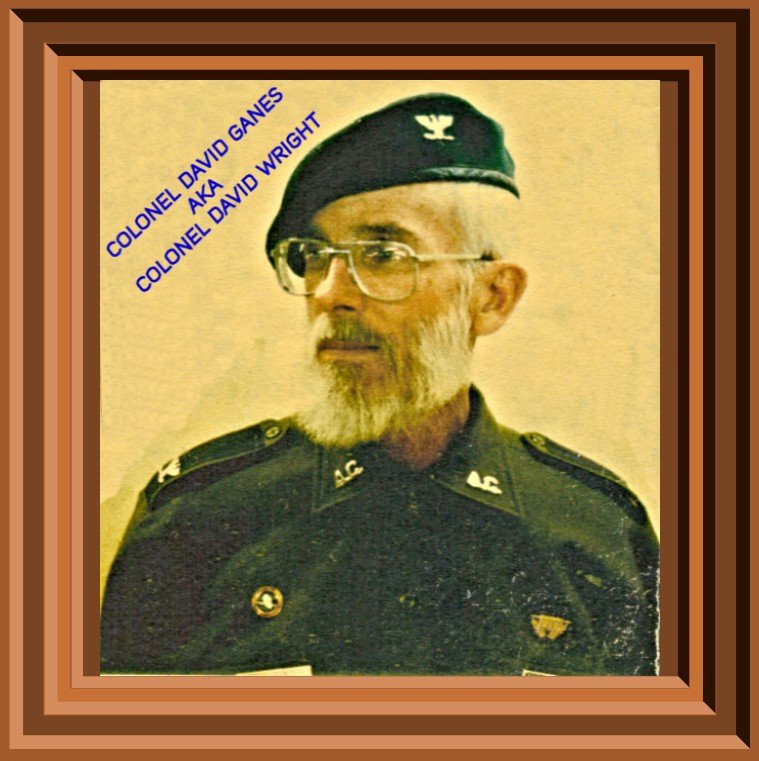
On p.59 Hill couldn’t resist, he brings up David Gain: “He had a wife & a daughter…owned several frame/art shops…which is to say, he had money”. He implies we recruited DG for his money. David came to us. His wife divorced him & he joined us. David is still with us today (also 80 years old as I am). He is a real trooper. Maura made sure David was included in her “made up” lawsuit. So, who actually was after $$? Us or her? She made lots of $$ off her BIG FAT LIES. But she will pay BIG TIME in the end (See Rev. 22:15).
Did you know I was summoned to the IRS Sacto. Office. Why? Because they couldn’t believe I gave 2/3 of my earnings to the ministry. They ended up giving me back several hundred dollars. Yep. Both Deborah & I gave most of our earnings to the Work of God. This others did as well. No one lacked in those days – until liar Maura sued us on made up charges. Ask her would she swear on the Bible that we abused her. Hill lifts her up like an angel, not knowing she has pulled the wool over his eyes. Don’t matter though, Hill wants 2 things: 1 – to destroy us entirely, 2 – make fame & fortune off our hardships. Now he is boohooing over our rebutting his book. Sorry, we’re not sorry. So, Hill himself has become a sucking vampire.
Who is Jamie Bridgewater?
By: Gen. Jim – 5/12/26

In Harrison Hills “Oracle’s Daughter”, chapter 32, he cites these quotes about J.B. “… A woman with a Caribbean accent asked for help ESCAPING (my emphasis) a cult…” She, J.B., was married to our son Joshua.“… She wanted to FLEE…” Escape? Flee? Yeah, words very much used by those “prisoners” we kept in camp. Maura, the “Queen of Liars” started all this “Escape” BS back in the late 1980s & still to this day claims she ESCAPED from the mean O Generals! Yep! “Please Pity me!” stuff. It was on the Dr. Phil T.V. Show that the world finally heard the truth-of-the-matter (see his 2006 show where he catches MS in her “want-to-be-true” genre, (see our PX2 Files).
Anyways, back to the J.B. “Escape”: In chapter 32, under Hill’s notes, here are some of his highlights:
“Firearms & ammo” – 6/29/16
“a child molester” – 6/22/16
“painfully disappointed” – 6/29/16
“Jamie said she would be happy” – 1/15/16
“They were hated” – 6/29/16
“would never eat” – Ibid
“acting like lesbians” – Ibid
“loves & owns guns” – Ibid
“His stomach swells” – Ibid
“And then there was Enoch” – 4/13/16
“I believe [Deborah] would have poisoned” – 6/29/16
“basically the brains” – 7/1/16 (from pages 314 & 315. There are emails.
Allow me to Present
I have before me 116 pages of email communications between JB & Deborah, dates from Jan. 12, 2013, to May 10th, 2013. These will suffice for my purpose, to give our readers the background of this N.Y. lady who wrote Deborah: “… I was drawn to NY just like Lot was drawn to Sodom & Gomorrah… No more half here & half there like a WHORE… I should be done packing &…” -email from Jamie Bridgewater on Mon., May 6, 2013 at 8:35 AM., to DG. Deborah writes her back.
These emails back & forth show us that Gen. Deborah did not recruit Jamie; she wrote Deborah for guidance. Here is Jamie’s first email:
“Dear Deborah,
My name is Jamie, and I sent you an email earlier on YouTube. The editor of the videos contacted me & told me that my message was forwarded to you & that I should email my contact info. My phone number is —-. Please call me or email me. Thank you, Jamie” Deborah emailed her.
Jamie wanted to know how to rid herself of demon spirits.
The first email was written to Gen. D. on Jan. 12, 2013, as already stated.
Jamie arrived in camp May 13th; She left (pardon me, ESCAPED!!!) Jan. 14, 2016. Maura, Sarah, Julie, Jamie, Anh Khuu all claimed to have ESCAPED ACMTC. Sarah actually told the media/Hill et al. that she & “lover boy” climbed over a rock wall, ESCAPING the mean o Generals (see our DVD, “The Late Great Gate” & the video short called “Rebutting The Oracle’s Daughter.” We also have articles up on PX3 & PX4 Files as well – all refuting their lies of “ESCAPE”.
Jamie B., according to Hills account, told the sheriff’s dept. “The children are treated worst (sic) than animals.” She went on to say, “Deborah FORCED (my emphasis) the children to eat food that adults would never eat because it is spoiled or rotting,” her very words! (page 244, OD). Hill wrote: “Serious health issues were present among members.” Jamie would have Hill’s readers to believe that the “children” were ill-nourished & sickly. Well, for the record Ms. JB, read our PX3 Files:
1) FBI Interviewed our 11 kids & Found NO ABUSE;
2) Kids REFUTE Accusers!;
3) Incest with the Kids???;
4) Malicious Malfeasance vs. FBI Docs on Kids.
5) Child Sexual Abuse???
The “kids” Jamie told the authorities are the very same “kids” the FBI interviewed and found NO ABUSE! ZERO! So, J.B. is a proven serial LIAR! She was the one who described in great detail the “mistreatment by the Generals “of Enoch Miller (who died of the flu – which that very year thousands DIED all across the U.S. of the same flu. Many here in ABQ, NM died in hospitals. Why didn’t the staff get arrested like we were? They had the best med service, yet several hundred died!
Jamie spends a lot of time on Enoch’s sickness/death. Why? she knew we would be charged. We were!
Hill, taking advantage of these female “Deborah Haters”, has to always twist things into some “many-starred constellation of CRIMINALITY,” as he puts it on page 238.
Apropos:
God Speaks to Jamie Bridgewater & Anh Khuu, aka, Beautiful.
Both of the women write in their emails to Deborah (2013) that God speaks to them (1) personally, in (2) dreams, in (3) visions, the very thing that Deborah has been condemned over & over by the media, Church, & individuals.
Jamie Bridgewater
Like I have said, I have over 100 pages of J.B.’s emails written to D.G. & D.G.’s responses. Those emails reveal the mindset of Jamie. Keep in mind that Deborah (or myself) did not recruit Jamie. She sought us out. (e.g., “My name is Jamie, and I sent you an email earlier on YouTube…”, 1-12-13).
Jamie writes:“… I want to be on the front lines for Him. He came to me in a DREAM in 2008… He asked me if I was ready to follow Him, & I said yes” (email written to Deborah Green on 1/12/2013 at 10:22 PM)
In her email written Jan. 16 to D.G. she writes: “… I do not want to forget the wonders & signs that God REVEALS to me..”
“You know I feel as if I am literally in a WAR ZONE… I felt as though the DEMONS attacked me…” (Jan. 22).
“Please pray for God to show me whatever is in my life that is grieving Him so badly…” (Feb. 21).
“… I am willing to pray & go wherever God tells me to go…” (Mar.6).
“… I did what God asked me to do today… It was difficult for me to do what God asked of me…” (Mar. 14)
“I will let you know as God reveals & confirms…” (Mar. 15)
Please take note of this next email:
“… although He told me… He also said that my deliverance and healing has begun. I am grateful… Now I am praying & waiting for Him to let me know exactly HOW & WHEN He wants me to CUT TIES with my family…” (Mar. 16).
We have been condemned for decades over this very issue: family ties. Nearly all reporters et al. have claimed that we MAKE/FORCE ACMTC members to cut family ties. Only after there is no agreement/unity between parents & children. But here Jamie is bringing up the subject, not Deborah. Jamie, in this email went on to write: “Only my mother is hanging on to me & exasperating my soul…” Deborah responds with:“… Now with reference to our conversation… His Spirit… sets us free, to bring you forth according to His timing & His direction…” (Mar. 16)
Another issue that we receive negative responses for is personal stuff-&-things. We are criticized over this issue – we either FORCE people to get rid of their personal belongings (photos is one) or give them to us! Yep! As if we need anyone’s stuff–&-things. Here is what Jamie Bridgewater wrote:
“… His Holy Spirit revealed… to me… what I heard the Spirit of God tell me to do: (she lists 7 things). Number 4 she says:“Sell / get rid of everything that is unnecessary…” (Mar. 16).
In her email dated Mar. 17, she writes: “God did indeed TELL ME not to tell any relative or friend about my potential move. He said that when I leave, no one must be able to CONTACT ME & no one must know where I am going to be…” So, here we have Jamie Bridgewater telling Deborah Green that God told her this. So, why are we so criticized for having a bit of secrecy? And may I ask, why is it a CRIME for us to keep God’s business private from the ungodly world? For sure, our pagan antagonists would never reveal to us their plans – yet they demand us to do so.
[note: I address all these issues in our PX2 Files: family/possessions, et al.]
Jamie Bridgewater openly writes about God speaking to her, something even H. Hill downplays in his evaluation of us, especially my wife, Deborah. But he uses J.B. as a true witness against ACMTC. I’m not implying that the Spirit never spoke to J.B., nor any other disgruntled x-member. I believe the Holy Spirit speaks – as does Satan!
Jamie writes Deborah: “… I know God MADE me see & hear… He MADE me listen in & see…” (email written on Mar. 19). “… The Holy Spirit already told me that the door for me to step through…” (email written on April 2)
Now Jamie hits on another issue we’ve been condemned for over the years: “Name Change”. She writes: “… I began to think about the times in the Bible when God changed people’s names to what He wanted them to be called…” (email written on Apr. 5) She is writing about Khuu changing her name from Anh Khuu to “Beautiful”. Beautiful had written to Gen. Deborah this: “Dear Generals, … every message that the Lord gives, every single act of obedience done unto the Lord is never in vain… my birth name is Anh. In 2011, Jesus Christ gave me a new name. My new name is Beautiful (see Rev. 2:17).”
So, here are two ladies telling General Deborah that name change is of God, yet the media (going back years) condemns Deborah for changing her name from Lila to Deborah. Well, FYI, it was the Holy Spirit that told G.D. to change names. (Khuu wrote this email on 3-19-2013. More on Khuu later).
Back to J.B.
Jamie writes: “… I read… ‘Women in the Ministry’. He (Gen. Jim) really confronts these controversies & dogmas head on, in length… I wish more men would see their horrendous mistake & repent for oppressing women…” (email written on Apr. 5) (see my article, “Women in the Ministry” – posted FYI).
I could quote from dozens & dozens of emails, but I have limited it to a few. I’ll go to some of her last emails now. She writes: “… I did a lot of talking & listening to Jesus last night…. I made a list of the (things) I heard in my spirit: (1) “… I am an orphan with dead biological parents, a fact! He doesn’t want me to even be trying to patch things up with my biological parents even in my thought life. GOD IS NOT PLEASED! (her emph.); (2) “… My biological parents & siblings are NOT MY FRIENDS (my emph.) either…. My biological parents offer me their perverted version of love so that they KEEP ME UNDER THEIR CONTROL (my emph.)… I must dispose of any & all attachment from those individuals who I am biologically attached to, for they are only trying to lead me back into the world through various means.” (3) “I need a new definition of the word family” (she goes on to write about this). (4) “Satan used my biological family… to destroy my physical body” (she includes her sisters). (5) Listen to this very carefully: “I HEARD GOD SAY, ‘You must HATE HER to LOVE ME.’ So, I told God that I did not understand how I must hate her (mother)….” She goes on to explain what “HATE” is in the way Jesus puts it (see Lk. 14:26: “If anyone comes to Me & does not HATE his father, mother, wife, children, brothers, sisters… he (or she) cannot be My disciple”).I have written on this text, taught on it as well. “Hate”, as Jamie describes it in No. 5, “to hate” in that context is not as “murder” but “hate” as “resisting”. Nicely put. We resist the world’s values, even family if they contradict God’s Word. This family issue is always brought up – starting back in the early days when the Sacramento Bee News / Channel 13 News uses this against us. But “separation” is Biblical when the Christians & non-Christians clash.
She continues (6): “… Jesus says that whoever does not gather with Him, scatters. In the same way, my parents are part of the ENEMY because they are not being fruitful for Jesus Christ. They are destroying & not building up, they are poisoning & not nourishing, & they love lies & not the truth of Jesus Christ… Therefore, they are the ENEMY…. They are in & of Satan, obeying his wicked commands.”
Now, rebellious, jealous haters of Gen. Deborah, what do you think of what Jamie’s – now an avowed enemy of us here – lesson on “family”? Each of you have condemned G.D. & me for saying the very same things.
Allow Me Please
Allow me to quote from some of the 1980’s Sacramento Bee News on “family”:
“… Some parents have grown concerned about personality changes they say their children have undergone since joining the group” (“Prayer Warriors’ Fight Myriad Demos (sic) with Vigor”, Sept. 25, 1984); by Diane Divoky);
“For the 3rd straight weekend, protesters on Saturday carried signs & walked around the 4 communal houses on X & 22nd Streets in Sacramento…. Calling itself ‘Parents Against Cults’ (PAC) they say that the group (ACMTC) is recruiting young, troubled adults & encouraging them to undertake long fasts & BREAK OFF TIES to their families…. Virginia Padilla (Julie’s mom), who said her 22-year-old daughter had been INSTRUCTED not to let Padilla see her 9-month-old grandson…. She received a letter from her daughter saying she wanted to BREAK OFF all TIES….”
Well, for the record, it was Julie who told us that her mom was an anti-Christ & into unlawful things, hence, she did not want to see her mother. Julie, after “ESCAPING” the mean ol’ Generals, has shown this letter – she wrote – in a recent video, showing her mother & Julie standing in front of Ft. Freedom. She claims (now) that she too was ABUSED by us. Funny, she stayed several decades with us & never once claimed ABUSE. She too now claims she was fed only peanut butter sandwiches like BIG FAT LIAR Maura Schmierer. (Why all the hate for peanut butter sandwiches? I like peanut butter sandwiches.) Now we wait for adulteress Sarah Green to claim the same. You see, all the “lying ladies” get attention, pity. Well, all liars will face the ONE TRUE Judge in the end.
You can go to our PX2 Files for lots more on this “family” issue. Nearly all those who have written articles, made docs bring up the family saga. They have zero proof, only what x-members tell them.
Bridgewater continues:
(7) “… I have to REFUSE giving place to my parents in my speech life & though life…”;
(8) “This is the conclusion I came to by the Holy Spirit.” Well, you can see that Deborah had zero input in her decision to BREAK ALL TIES with her family. She writes: “These are astonishingly truthful, especially in light of the written Word of God…” Yep! The very Word of God Deborah & I teach/preach from. So, why are we condemned over preaching/teaching from God’s Holy Bible?
She finishes up with “… They are dead because they continue to choose death in Satan…” (email written on May 8).
Her last email: “… I look forward to your call…” (May 10, 2013)
Who Was Anh Khuu?
By: Gen. Jim – 5/15/26

“A woman with a Caribbean accent asked for help ESCAPING a CULT outside Fence Lake (N.M.) – could someone from the Sheriff’s Office come pick her up at 7:00 p.m.? The woman’s name was Jamie Bridgewater. She wanted to FLEE with her eleven-month-old son & a disabled friend from the group.” (The Oracle’s Daughter, chapter 32, page 231)
That woman who called for HELP! was Jamie Bridgewater, the wife of our son, Joshua. She was black & East Indian. That call was made from our ACMTC office where she worked. There were computers and phones. Does this sound like a prison to you? This call took place on Jan. 15, 2016. The disabled friend was Anh Khuu who had met the Lord at age 19, Sept. 6, 1999. She was born with cerebral palsy and was in a wheelchair when she arrived at camp.
Now We Start
Like Jamie Bridgewater, Anh had emailed Gen. Deborah and so began an extended communication between the two.
As with Jamie Bridgewater, I will show our readers what Anh Khuu, aka Beautiful, wrote concerning certain issues I covered in Jamie’s emails. Her first email is dated 3/19/2013. I will cite certain emails from the stack of pages before me (73 pages). Note that these emails were written to General Deborah Green for several months BEFORE Anh Khuu aka Beautiful ever joined ACMTC.
She writes (March 20), “In 2011, Jesus TOLD ME (my emphasis) He was going to heal me completely inside & out, physically too. Jesus also TOLD ME that… The whole world will know that it is by His power alone that I stand.”
My point about these two former ACMTC members is that long before they set foot in our camp, they wrote about God / Holy Spirit / Jesus SPEAKING to them, showing them visions, giving them dreams, something Harrison Hill et al. doubts when in reference to my wife, General Deborah. Just about every article written about/against GD brings up, “She says God speaks to her!” or something like it. Hill always puts doubt over the minds of his readers concerning spiritual things – as if Deborah is not a TRUE BELIEVER, but a fraud, a fake. All General Deborah haters (& Gen. Jim) love to use the words “self-appointed”, as if God isn’t in the business of appointing & anointing those He has chosen. My point being, Hill, we claim, is a “self-appointed” judge over us. Who actually appointed him to evaluate our walk with the Lord Jesus? He seems to have a subtle dislike/hatred for Deborah, who had laid her life down for the Gospel’s sake since 1971.
Khuu ends her email with: “First I saw a link to one of your YouTube channels that said, ‘Join the Army that Sheds No Blood’.” Now note what she then writes: “Not long after, I had a dream given by the Lord, & your message went along with the dream…”
When Deborah speaks/writes about the Spirit/Lord speaking to her or giving her dreams & visions, she is considered a witch, a fraud etc.
Anh Khuu in another email:“Dear Generals: Jesus Christ TOLD ME to send these messages to you,” she writes in her following email. In another email she writes: “I remember the day the Lord Jesus gave me my new name.” This, too, as I wrote about in Jamie’s emails, God does give new names to His people. But Deborah is mocked for taking the name, from Lila to Deborah. Lila was her dead/non-Christian name: Deborah is her living/new Christian name (see our PX3 & PX2 Files).
Khuu continues: “And then I heard Him say the word, ‘Beautiful’.” She continues: “So, when I talked to the Lord about my new name…. Then the Lord SPOKE to me, ‘Do you remember the first thing you ever prayed?”
Sunday, Dec. 16, 2012: She writes a long email to Deborah about “Beautiful”. It is really good. Do I believe God spoke to her? I do! She ends her email, “… To know Me (Jesus), to obey Me, to follow Me, to choose what is right; to choose Me. But I will force no one to follow Me.”
She sounds like she is preaching one of our sermons. If this was actually the Holy Spirit / Lord Jesus speaking to her, “But I will force no one to follow Me” has always been our stand here at ACMTC. Over & over, through the decades the media / the backslidden Church and the former ACMTC members keep saying we FORCE people to do this, do that stuff. We HOLD people CAPTIVE. We KEEP a watchful eye on them, never letting them out of our sight! The truth is, we’ve never held a single soul against their will. Yes, we are strict (the Bible is very strict) but if a person does not want to go the way of the cross (dying to “self”), then they can leave. All this BS about ESCAPING is pure HYPE!!!
God’s Got An Army
What? Yeah, even Christians doubt this. Poor souls. Khuu writes: “I belong to the Army of Heaven,” (email written on 2/25/13). She continues: “Jesus Christ is my Commander-in-Chief… I belong to the Army of Heaven. I belong to the Army which sheds no blood – because the blood of the sinless, spotless Lamb of God was shed for us… was shed for the sins of the whole world…”
This lady was saying this before she ever joined us. In this particular email she puts forth a stirring sermon about God’s Army: “I am a woman under Authority. I submit myself under the Authority of Jesus Christ, no one else…” This has always been our declaration. Although God uses us for His physical reps on earth, we KNOW who is the real Authority – it is God, not us! Actually, she gives a bold proclamation against worldly authorities (this was written during prez Obama’s reign of Terror!)
We’re not sure what made Anh turn from what she said – God told her to come to ACMTC – to ESCAPING! I think Jamie Bridgewater talked her into leaving. Remember, she was in a wheelchair. We all took good care of her, despite all the LIES spoken that we ABUSE members. Well, we’re yet to see a medical report of ABUSE from our enemies, talk, but no proof.
Anh was living in Orlando, FL when she began to correspond with us. Now note this (as noted in Jamie Bridgewater’s testimony): (Deborah had asked, “How do they (your family) feel about your Christian life?” Anh responds: “They do not accept me, my life in Jesus” (she was from a Buddhist background). “I left my parents home in 2001.” What? You mean mean ol’ Deborah didn’t tell you to leave your parents? She continues: “The Lord TOLD ME when I was young in the Lord that I needed to LEAVE my parent’s home. In 2001, Jesus TOLD ME I couldn’t grow any further in my Christian walk under such DEMONIC OPPRESSION (my emphasis) if I stayed. So, Jesus made THE WAY to leave…. They are DECEIVED. Will you please ask the others there (ACMTC H.Q.) to pray, too?” (4/1/13)
On Dec. 1, 2011, she emailed:“Destruction will come on America…. They will know that (the LORD GOD) is King of Kings…. (she quotes Scripture)“I AM coming quickly… Destruction is coming quickly!” She ends with,“Destruction is eminent, Destruction is coming for America…”
In her email dated 12/10/12 she writes about the Lord speaking to her: “My daughter, cry not for this family any longer…. Do not cry!… This wicked, wicked family…” On 4/11/2013, she emails Gen. Deborah this: “The Lord has SPOKEN to me this afternoon… I must prepare to leave now…”
On 4/22/13 she writes: “I love you so much, Gen. Deborah. I am grateful for who you are in Him…. only under direct command from the Lord Jesus have I contacted you myself…” You see, we did not recruit Anh Khuu nor Jamie Bridgewater – they contacted us. Hill accuses us of going world-wide recruiting souls. Well, he is only half right. We do recruit but many request to “Join the Army that Sheds No Blood.” All the ones in Hill’s fiction/ supposedly non-fiction book joined of their own free will. Yet, they now claim we held them CAPTIVE. Makes his readers want more & more “The Generals are insane, wicked, evil, … put them away for life or murder them!
Fin
I have covered the two main points (of contention): 1) God speaking; 2) the family. If you go thru PX2-4 Files you’ll see that these two are controversial. Since the first media article was published about/against us, up until the “Oracle’s Daughter” was published (April 7, 2026), these issues are always brought up. (Please see “Inside the Aggressive Christianity cult”, a doc posted at our PX4 Files under “For your consideration”. It is AI. It addresses “abuse”, “isolation”, & “a deadly faith”. It is a masterpiece of dis/misinformation, outright lies & deceit – must see!)
Many docs/articles always brings up the “multiple felonies” but never tell their viewers/listeners that those “felonies” were dismissed – kidnapping, child abuse (sexual/Physical/emotional)! Be blessed!
What? Burned Down All Our (Art Shop) Stores?
By: Gen. Jim – 5/18/26
While I was surfing thru state of NM (Plaintiff, vs. James Green, et al, Defendants [Transcript of Grand Jury Hearing, Feb. 23, 2018], I came across this:
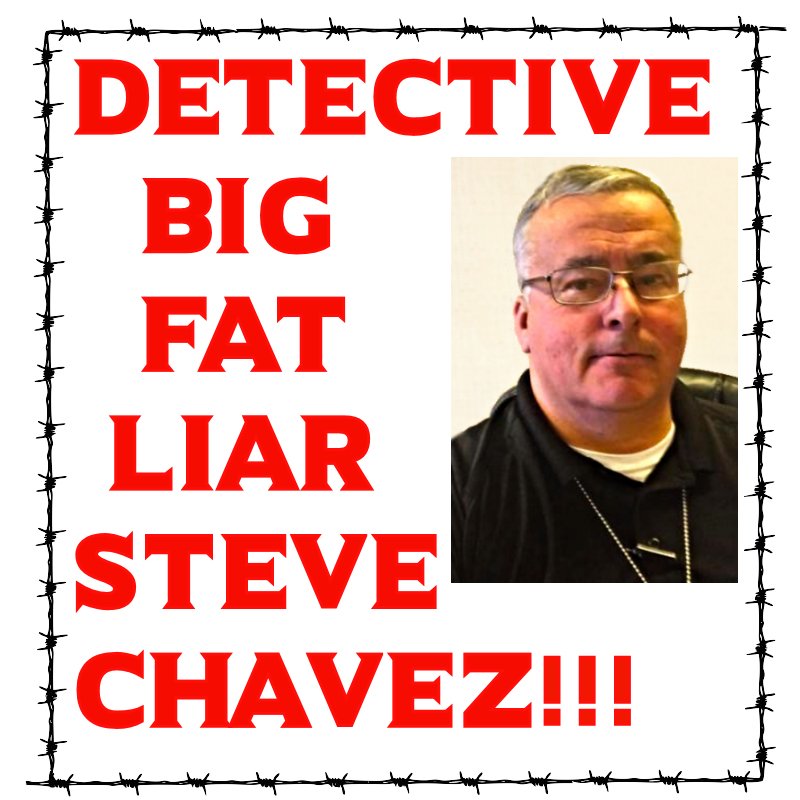
Det. Chavez:
“Okay, so again this is – this is a commune – it’s Christians based is what they call themselves. And so immediately – & they – they talk the talk, but the reality is that the commune started in – in the 1970s in Sacramento, CA.”
LIE: ACMTC was started in earnest in 1982-1983. We first were called Free Love Ministries (God’s “Love” is free!).
Det. Chavez continues:
“They started a commune there & got up to a hundred members at that time according to the Generals, what they told me. They were sued by a member there for locking her in a storage shed & feeding her only peanut butter for several months.”
LIE: This lie has been debunked years ago – why Detective Chavez continues to spread this as being true just shows how corrupt he was/is! This was written about in many CA. Newspapers & reported on several T.V. stations (see our PX2 Files for the TRUTH.
Det. C. cont.:
“So ABUSES (my emphasis) began back then. When she (Maura Schmierer) won the lawsuit (she only won by default, not by proof!) in CA., in Sacramento, they BURNED ALL their store fronts because at that time they were selling picture frames…”
BIG LIE!: We operated 5 successful Art Shops (which won awards in Sacto.), owned by Col. David Gain. We hired our members, hence, we were self-supporting – no begging for $$$!!!
I don’t have the foggiest idea where Chavez came up with the BURNING genre. That would be considered a felony Big Time! Not a single news report of this happening. Why did he make this up? He was a DIRTY cop!
Det. C. cont.:
At least he makes one true statement:
“They were very resilient folks. They’re not – they’re not lazy. They work hard….
Lie: “Well, when she won the lawsuit, they BURNED everything they had & they moved to Oregon.”
This was never reported in any media outlet – and trust me, we were WATCHED day & night, year after year. However, Maura’s attorney, Robert Blasier, a criminal lawyer, told it around that we burnt down barracks 3. But this did not happen. After we left Fort Freedom (left 4 houses empty), someone – not us! – set fire to it. Eventually the State of CA tore it down & established a parking lot on that space. In some of the videos we made (or made for us), shows the house being torn down by the State.
Q. If this were true – why didn’t Robert Blasier go to the police? Remember, Marua & Robert conspired together to take possession of our 4 houses which we bought & paid for out of our hard labors. THIEVES!!! No police report! And, unlike what Chavez told the Grand Jury (under oath!), we did not burn everything. Even our avowed enemies never mention this, no, not even the anti-ACMTC media.
There are SO MANY LIES Chavez told, I can’t deal with them. He throws in kidnapping of 9 Ute (Indians) children. He says we brought them to Fence Lake under false pretenses. How does he know this? We opened up a school on their Reservation. He tells the Grand Jury, “… they were going to reopen the boarding school here (NM), but what it was, was they made the children do labor.” What? What labor? We needed no outside help. We had many children in camp that helped when help was needed. Chavez makes out like we FORCED children to WORK! Why weren’t we investigated for child labor? It didn’t happen!
This dirty cop goes on & on about “criminal” things we allegedly did.
Well, by now, most of the things we were accused of doing have proven to be false.
As Per Art Shops Burnt
Allow me to quote the Sacramento Bee News, May 17, 1989, by Richard Abrams, Bee Staff writer:
“Setting It Straight”: An article on pg. B1 Wednesday incorrectly stated that the assets of an art supply shop on Ardern Fair mall had been seized. The Store, The Art Shop, is located at 2933 Arden Way, not in the mall.”
This was our main Store where many members worked. the article continues:
“Sacto. Co. Sheriff’s deputies Tuesday trucked away the inventory of 3 art shops owned by Free Love Ministries as part of attorney Bob (Robert) Blasier’s continued efforts to collect 1.2 million (the original suit was $20 M!) judgment against the radical Christian group. Locks also were placed on the doors of art supply shops at Florin Mall, Arden Fair Mall & in Yuba City, with contents stated to be sold at public auction, Blasier said”
Now, be honest, does this even sound like what Det. Chavez told the Grand Jury – we BURNT ALL the Art Shops!!!???
Blasier, in this same article, says that we did not fight the suit in court. I explain this in other articles. (see PX1 Files for Sacto. News articles) I could quote from more sources about the Art Shops. They were never BURNT DOWN – Chavez lied!!!
Concerning the Death of Enoch Miller
By: Gen. Jim – 5/16/26
In Oracle’s Daughter, written by Harrison Hill, released to the public on April 7, 2026, on page 315 (under Notes) he cites Jamie Bridgewater email (6/19/16): “And then there was Enoch: This account of Enoch Miller’s death, & including all quotes, is drawn from testimony provided by her ‘written Testimony of Enoch Blessed River’s Death & Illness’, (4/13/16). I have used Enoch Millers real name with the permission of his father, Brian Miller, who told me he wanted his late son’s name ‘proclaimed loud & clear.’”
More on Brian later. Why did he leave ACMTC? Where did he go? Why didn’t he provide for his wife & his 5 children: Enoch, b. 2001 – d. 2014; Benjamin, Aaron, Barney, Charity, Enoch the oldest. Brian never sent one red cent for support, nor did he ever try to talk to his family, his (many) calls were recorded by us, but, be WARNED they are ALL X RATED, mostly directed against Deborah, who had been taking care of his wife & 5 children.
On page 235 Hill writes: “In her (JB) interview with (det.) Chavez… Jamie laid out a tale as tragic as it was unsurprising.” Note the word “tale”, exactly! A tall tale. She basically says that the Greens are the cause of the flu that swept our camp (the whole US). Here we have a supposed expert eye-witness spitting in the ear of det. S. Chavez (avowed enemy of us!).
Hill writes: “Then, one day,” according to Jamie Bridgewater’s BS!, “Deborah said Enoch needed to eat – but only because Deborah ‘got very afraid that she would be later accused of starving Enoch.” Yep! JB et al. has accused us of either starving the children or feeding them rotten food. This accusation can be found in Oracle’s Daughter & other legal docs (which I have to prove it!).
I can’t recite all that Jamie/Hill says in the book, but you can get one for yourself & read what slander, false accusations, and lies were said by Jamie Bridgewater & Harrison Hill.
Of course, one can’t believe all that either say/write. There were dozens of others in camp that have a different view than Jamie’s. she has to make it sound like we were some sort of hard-hearted cultists with no mercy. Did you know in ABQ. NM alone, dozens died from that flu in the best hospitals – will the state arrest the staff?
Grisly & Barbarous
On page 238 Hill writes: “over the course of his career, Steve Chavez (proven later to be a BIG LIAR!) had worked on all sorts of horrific cases – child abuse, child death, child rape. But Deborah’s alleged (so declared, but without proof or legal conviction; so called) CRIMES (my emphasis) were so grisly & barbarous as to have virtually no comparison.” No comparison Steve? Really? Someone needs to fact-check this lying detective. You mean cutting up a child into pieces (which was in the news when we first were thrown in jail, in ABQ. NM) does not compare to seeing a 12-year-old die of the flu?
Now hear this: “Jim was equally culpable, as far as Chavez was concerned, a ‘fu*king cunt’ for failing to stand up to his wife.” Did Chavez call me a FC or did Hill call me a FC? There was no need to stand up to Deborah, I was there (although sick with the same flu). It was Enoch’s mother who refused medical help – and the state knows this! She went to prison for her “crime”. Even this Big Fat (lit.) detective knows this, for he came to the same jail where Deborah & I were and tried to convince her to lay all the blame on Deborah. She refused! Thank God, some had the guts to stand up to the NM corrupt legal system. Just about everyone in & around Cibola County knows that Sheriff’s Department is one HELL of a corrupt department. Deborah’s attorneys & lawyers put forth a strong defense against their lies, but the State ignored it entirely. You see, NM DID NOT WANT ACMTC in NM. (see PX3 Files where her Attorney & Special Agent Pete Baca discuss this).
On page 239 Hill writes: “… Chavez & Munk (red-faced / hostile under Sheriff) went to Truth or Consequences to speak with Stacy. Chavez knew Deborah had played a pivotal role in Enoch’s death & pleaded with Stacy to concede as much.” (I’ll give Hill credit here. He at least gets it right. Chavez & Munk wanted Stacy to place the blame all on Gen. Deborah!). Hill continues: “But Stacy refused, claiming full & exclusive responsibility…”
For the record, the main reason Stacy refused to take Enoch to the hospital is because she was scared. The State of NM had made her afraid to take a sick child to the hospital because when Miracle had broken her leg while playing on the swings in our playground and we (Deborah and I) had taken her to the hospital, the NM CYFD accused us of child-abuse and took Miracle away from us. Stacy kept refusing all offers to take Enoch to the hospital and was wanting to trust God to heal Enoch of the flu because she was afraid that the NM CYFD would take him away from her if she took him to the hospital. So, really it was the State of New Mexico’s and CYFD’s fault that Stacy Miller did not take Enoch to the hospital! Also, it is very possible that Enoch actually died of JHD -juvenile onset Huntington’s Disease since his father Brian Miller had an uncle who died of JHD at the age of 19. Look it up. This disease JHD is a cruel disease and is inherited primarily when the faulty gene is passed on from the father, however you need to be 18 years old to take the test and Enoch died when he was only 12.
The conversation continued between Steve Chavez and Stacy Miller. Hill continues, “But Stacy held firm. [Deborah] just came right [out] & told me; she said, ‘If you want to take him to the hospital I stand by you.’ And I said ‘No!’” This was done at least 3 times that I’m aware of. I was with Deborah when she plead with Enoch’s mom to take him to the hospital. Yet, the State has ruled that Deborah needs to PAY for her CRIME!!! What crime???
Pt. 2
I now want to turn our attention to what the FBI (Special agents that deal with children). Remember the 12 questions asked by the FBI? (Aug. 2017) (see PX3 Files)
They took 11 of our children in for questioning. In part 2, I want to deal specifically with Q #7: “Anything about Enoch Miller (Stacy Miller/Gracious River’s Son); his illness, his death, what they were told (& by whom) about his death, his burial, what happened to his clothes, any pictures of him whether they were told to not mention him, etc.”
I’ll start with the oldest (14) at that time: (I will not disclose their names for reasons you already know. I’ll use the first initial only).
“E” (Male) was 14, now 23, the first to be interviewed. This was recorded by the Sheriff’s Dept. & FBI (videoed). I will not give the whole interview (all are long); I will only quote what the FBI wrote down after the interview concluded:
(1) “E”: “Everyone was sick with the fever, but Enoch stayed sick & got sicker. Enoch was taken to ‘this place where these people took care of him, but they couldn’t keep him alive & he died.’” The FBI comments: “E” didn’t know the specifics. Sick for quite a few days, maybe a week, he wasn’t exactly sure when they all got the fever, Enoch’s got worse… his eyes got puffy, breathing problems. He could still walk around though. After they came back from the place, they buried him.” (note: we had a legal graveyard at Fence Lake community) “E” said “the police wanted to see him, so they dug him back up & they took him.” (“E”, 14 years old)
(2) “E” (same initial) (female): (Enoch’s death, #7)
The therapist asks what “E” misses about Enoch when he was here; “E” continued to say she’s just glad he’s in heaven, it’s much better up there. She says, “they all got sick,” and he ended up dying. If they took him to the hospital, there was nothing they could have done to help him; they did not take him to the hospital. There was no reason to take him, a huge hospital bill, it was God’s time for him to go anyway.” The FBI says, “E” didn’t know how long he was sick for, maybe a couple of days. The whole camp was sick, but it just affected him worse than them.”
FBI: “What did he look like when he was sick?” “E” said he got a little bit pale. FBI: “Where was he mostly?” “E”: “He was in his mom’s room. People were able to see him, but he was sleeping a lot & they didn’t want to disturb him.” FBI: “How was he acting?” “E”: “Tired, wanting to sleep, like how’d happens when you’re sick…” FBI: “What did they say when he died?” “E”: “They just told them he died. The adults told the kids. Then they buried him on the property.” FBI: “How did they pick a place to bury him?” “E”: “They have a little place.” FBI: “Is anyone else buried there?” “E”: “Yes, Philemon & Joab. A doctor never came for Enoch…” (“E” – 12 y.o.)
(3) “C”: The (FBI) therapist asks if he knows Enoch. No dialogue given. (“C” – 4 y.o.)
(4) “D”: The (FBI) therapist asks what happened with Enoch, D said he had the bird flu really bad, that a lot of people in NM got sick & died. A lot of people at the camp got the bird flu. The therapist asked how he was acting when he got really bad, D didn’t see him much, everyone was really sick… the people tried helping him. Therapist asked how, D said he doesn’t know because he wasn’t around much because he was sick too. Therapist asked where they buried him; D said he didn’t know. D talked about another person who died of age, & got cancer – Joab. (“D” – 11 y.o.)
(5) “I”: The (FBI) therapist asks about Enoch, I says he was sick & couldn’t walk & died. The therapist asked what made him look like he was sick, I said his head was red; he could barely move his arms. The therapist asked what happened when he died, I said they buried him; the adults. The therapist asked if there was anything they did for him, I says they prayed for him & gave him vitamins.
The therapist asks if Enoch was ever taken to the hospital, I shakes his head “no”. The therapist asks if he knows how come, he does not know. (“I” – 7 y.o.)
(6) “J”: The (FBI) therapist asks what happens when they get sick? J says they lay us down & let us get better. That everyone prays for them. The therapist asks about a broken bone or something like that, J says they’d fix it, that his dad would put the bone back in place & wraps it up. But it’s never happened. The therapist asks that she heard someone had really burned their fingers, J said I’ve never heard about that, then the therapist asks well what would happen if someone got burned, & J responds they’d put coconut oil on it; the therapist asks what about really bad times, & J said that’s never happened.
Enter Det. Chavez
Chavez asks if he remembers Enoch, J says no.
Chavez: “What were you told about what happened to Enoch?”
J: “They never told me nothing.”
Chavez: “No? Did you ever wonder?”
J: “No.”
Chavez: “Well, he died. That’s what happened.”
J: “I only got told that he died because of his eye, something got infected with his eye” (“J” – 7 y.o.)
(7) “J” (same initial): The (FBI) therapist asks if anyone else was sick when Enoch was sick, J says he got the bird flu, that everyone did, she doesn’t remember how old she was. (“J” – 9 y.o.)
(8) “J” (same initial): The (FBI) therapist asked what happened to him (Enoch), J responds he died. The therapist asks how, J doesn’t know, keeps saying he died. Then he says he died then they buried him. The therapist asks where did they bury him, J says “places & things”. (“J” – 11 y.o.)
(9) “N”: The (FBI) therapist asks that she heard Enoch got really sick & died , tell me about that, N says something happened, NO ABUSING (my emph.), they said (other people not of ACMTC) they killed Enoch. They (adults) did not!, nobody in the camp knew, except Momboo (what the kids called Gen. Deborah) knew what happened, God talks & stuff, he’s listening to us right now. (“N” – 9 y.o.)
The therapist asks so you said Momboo knows what happened to Enoch. N says no she doesn’t, I never said she did, I said no. She only knew something was wrong because his eye was puffy & nobody knew what it was & now the police did something, they killed him. It wasn’t a bullet or stabbed, it was his eye. We are Christians; Christians don’t kill! N continues, & they blame it on us saying why didn’t you go to the hospital to get him better? Well the reason we didn’t do that is because God heals us & just because God didn’t heal one person doesn’t mean God’s not real. He’s still real because he heals all the other cuts. He loves everyone.
(note: many of us have received healings over the years. Deborah had been healed of life threatening cancer 3 times – she remains cancer free today. Why God doesn’t heal everyone, every time, no Christian can answer that!)
(10) “P”: The (FBI) therapist asks if she’s ever been sick P explains about running around outside & feeling hot & her head hurt; her mom helped, gave her some food. (“P” – 5 y.o.)
(11) “Z”: The (FBI) therapist asks about Enoch, Z says he had the bird flu, the sickest of everyone. He said they took him to a Christians hospital, that his dad (Z’s dad) is the one he thinks drove him there. Then after the hospital, he died, Z says he died in the hospital & that was it.
(note: “Z” who was 5 years old when Enoch died, is the only child to say this. He no doubt got Miracle mixed up with Enoch, in which she was taken to two hospitals when she broke her leg while swinging).
The therapist asks how he (Enoch) acted when he was really sick. Z says he just laid down a lot; he couldn’t get up to go to the bathroom, so he was in diapers. That he would change his own diapers. That therapist asks where he was at when he was that sick. Z says he laid in his room. They could see him anytime; there were no rules.
Therapist asks how long Enoch was sick, Z said he doesn’t remember because he was really little (5 years old). (note: Enoch was 12 at his passing and Z was 5). “Z” – 9 y.o.)
Ok, I’ve recorded for our readers notes taken from the video interviews. Remember these were some of our kids, the FBI/Sheriff Dept. picked. Not one word about ABUSE! In Harrison Hill’s book, Oracle’s Daughter, Jamie Bridgewater goes out of her way to demonize our camp. So does Detective Steve Chavez. Let me repeat what Hill printed on page 238:
“… Steve Chavez had worked on all sorts of horrific cases – child abuse, child death, child rape. But Deborah’s alleged CRIMES (my emph.) were so GRISLY& Barbarous (my emphasis) as to have VIRTUALLY no COMPARISON (my emphasis). There was no way to explain what she had allegedly done, no framework of understanding that could help it make sense. Jim was equally culpable as far as Chavez was concerned, a ‘fuc*ing cunt’ for failing to stand up to his wife.”
Well, well, well, if this is not character assassination then I don’t know what is!!! Just what did Deborah do that was SO CRIMINAL? It is a known FACT that Deborah asked Enoch’s mother if she could take him for medical treatment. She refused (see my article at AC.com, PX3 Files under Gen. Jim’s Articles on Truth vs. Lies – “Damned if you Do; Damned if you Don’t).
And Ms. Bridgewater exaggerates to the point of absurdity. She was the camp bully. She played the “race” card to get her way (being half Black, half East Indian). The older girls in camp and the adults have a very different picture of Jamie Bridgewater. All the kids didn’t like her. She was HIGHLY jealous of Deborah, hence, she wanted to destroy her and our marriage. This is FACT!!!
Hill writes on page 240: “ACMTC had been the subject of previous investigations, of course…. the volume of evidence or the credibility of Jamie Bridgewater’s & Brian Miller’s allegations…” Their “credibility”? Both “liars” and “haters” of Deborah. And, what about the Sheriff’s Dept.? They too wanted to DESTROY our community at Fence Lake. Det. Chavez, we all believe, manufactured much of the genre of ABUSE. He too is a serial liar.
FYI
Because we get requests from all over asking about Enoch’s death, I have presented notes taken off the actual video interviews of 11 of our ACMTC children – the very children Sarah Green says were being molested (incest she calls it). You need to read “Incest with the kids”??? WHAT THE HELL?!!” by 1st Sgt. Amos.
I also have the FBI notes taken from the 11 children’s (videoed) interview (see #3: “Any ABUSE or NEGLECT of any of the kids at the camp; discipline, spanking, bad food; basically anything that might be perceived to be any kind of abuse or neglect?”) You will be surprised at what each child answered – something that the State of NM did not expect or want to hear.
Maybe later I’ll post their (FBI) notes. You can see by now the authorities have their own SCREWED, i.e. TWISTED genre & we have ours. Who knows more? Those of us who lived in camp or those outside looking in? As for those who collaborated/colluded with the anti-ACMTC outsiders, they had an axe to grind as Special Agent Pete Baca – NM State Police – told General Deborah’s attorney several year ago.
As per Det. S. Chavez, he was fired from the Chief of Police (Grants, NM) after he failed to be elected Sheriff. And why was he fired? Oh, yeah, sexual harassment! (see “Candidate Spotlight: Stephen Chavez – Sheriff (June 1, 2022, Cibola Citizen): “After a rocky departure from Grants Police Dept. where he was the previous police chief, Stephen Chavez is looking to become Cibola County’s next Sheriff. His time as police chief was muddled by crisis after crisis… this set into motion a chain of events that culminated in SEVERAL sexual harassment complaints & a massive walkout of employees…”
There you have it: ACMTC BASHER & LIAR getting booted out the door!!!
Q. Do you think he made up a lot of those charges against us?
Chavez told the Cibola Citizen, “I am the man for the job (Sheriff). Not because I have the personality, honestly, I’ve always been kind of an introvert (sexual pervert too?) & not a very charismatic type person, but I’ve also been HONORABLE (my emph.) with my dealings with society.” Yeah, right! This fraud, liar, deceiver was not honorable/honest with us, especially Deborah. We KNOW he cut a deal with our daughter, Sarah Green, when he flew up to NY to interview her for Deborah’s up coming trial. This NM detective threatened her with prison time (over her bringing an African baby back to the US, without proper papers. Deborah was charged with kidnapping! Yep! Sarah, to avoid prison time cooperated with the NM authorities to place the BLAME on my wife, her own mother. I wrote Sarah while in prison telling her I KNEW what Chavez did. She lives now in FEAR of being arrested for kidnapping. So, Sarah & “honorable” Chavez were responsible of putting a felony upon my wife for something she (we) had nothing to do with. You don’t read about this in the news, nor is it presented in anti-ACMTC docs. Oh, no! Lies sell!
In another Cibola Citizen article, A New Direction (Oct. 20, 2021) tells us “Grants Police Dept. Chief Steve Chavez resigns” (basically kicked out!) The article states: “… the Grants Police Dept. staff must give the Chief (Chavez) respect. Officers were angered at the time by a series of issues at the dept., by the time the July 25, 2018, report was written, there had already been five – FIVE! – sexual harassment grievances filed against the Chief, many of whom claimed he had dug too deep into their personal lives.” Yep! This is what he did to the ex-ACMTC (female) members.
All the female soldiers & officers at ACMTC say Chavez was a “dirty ol’ man” & he gave them “the creeps!” I’ve talked with this pervert many times. He is smooth, compelling, yet underneath lies a serpent! Some of his relatives had told us he was dishonest (and things I won’t print).
Fin
So, you can see that there was & is a conspiracy to destroy Deborah & ACMTC in general.
More to come…
“What Draws People Into Cults?”
By: Gen. Jim – 5/25/26
That headline is taken from NPR (National Public Radio), April 9, 2026. NPR, under Book Reviews written by Ilama Masod, follows up with “A new book tracks the journeys of two followers.” Their article is rather short. The author of the article quotes Harrison Hill: “But Deborah looked so small, so frail – so old” when she was arrested.”
NPR continues: “A gaunt, bespectacled, 71-year-old woman wearing a crisp white uniform with two stars on the shoulder was arrested in New Mexico.” What NPR and other media outlets don’t say that Deborah was arrested on FALSE CHARGES & sentenced to a 72-year prison term!
The writer continues: “This was Deborah Green, (sic) nee Lila Carter, the leader & self-described General of the ACMTC – a cult that had been operating with impunity for three decades, despite various attempts by former members to get law enforcement to shut it down.”
Yep! Many over the decades tried to STOP us from doing what God called us to do – Build Strong Christian Soldiers!!! (Click on “Spiritual Warfare & Revolutionary Articles”, at AggressiveChristianity.Net, page 1. Here you will find the following articles:
(1) Committed to Revolution
(2) God’s Boot Camp
(3) Above & Beyond
(4) The Weapons of Our Warfare
(5) Soldiering for the LORD
(6) Royal Proclamation
(7) Marching Into Battle
(8) Slaying the Enemies
(9) Witness, War While you Wait
(10) At WAR Against the Big 4
(11) Behave Valiantly
(12) Par Excellence
(13) Why Cast Out Demons?
(14) Spiritual Warfare
(15) Are Demons for Real?
(16) Storm the Gates of Hell
(17) Walk in Dominion, 1-4
(18) Warrior’s Most Powerful Weapon!
(19) Manifested Soldiers
(20) Satan, Our Enemy, parts 1 & 2
(21) Want to be a Soldier?
(22) AIRBORNE
(23) Ready, Aim, Fire!
(24) War, Death & Destruction
(25) Eternal God – Eagle Soldiers
(26) Unyielding Revolutionary Faith
(27) Time for Revolution
(28) Aggressive & Militant
(29) Restoration Revolution
(30) Arise, Dive in, Take Action!
(31) Internecine Struggle
(32) Spirit Combat
(33) No Discharge from War
All these articles (& dozens more at other sites) prove that N.T. Christianity is a war, THE WAR, against the forces of HELL (see Eph. 6:10-18 et al.), which brings me to what the NPR article WRONGLY states about us: “… the Green’s vision of a spiritual army that would ‘take up ARMS (my emphasis) against the forces of secularism & mainstream Christianity.’” Hey, don’t all you “lefties” take jabs at the Church every opportunity you get? Oh, all you anti-conservative Christian bashing outlets can’t wait to denounce the Church, be it a cult or otherwise.
Apropos – fitting the occasion – assassinating Christians’ character is one of your MO! Here you would like for your readers to believe we have “arms” / “weapons”. I’ve debunked this BIG LIE many times. Our “weapons” are not carnal, i.e. physical, but “spiritual” as 2 Cor. 10:3-6 tells us. Read those Scriptures!
“Ruler Cult”
The word “cult” has been thrown around now for decades. The media started calling us a “cult” since the very early 1980s. They also called us a “sect” as well, meaning we were outside the box called “church”. What’s new? Jesus in His day was outside the box called Orthodox Judaism.
The New World Dictionary of American English defines “cult” as (1) a system of religious worship or ritual, (2) aquasi – religious group, often living in a colony, with a charismatic leader who indoctrinates members with unorthodox (remember the “religious” said this about Jesus) or extremist views (also, Jesus), practices, or beliefs, (3) devoted attachment to, or extravagant admiration for, a person, principle, or lifestyle, (4) a sect. You can see by these definitions that just about everything in social/religious/military/political et al. USA is “cultish!”
True, there are both good and bad cults. But WHO is the judge that makes the distinction? To hear the Leftist/democrats tell it, the Right/Conservatives/Christians are the “bad, bads” & they are the “good, goods”. Likewise, who decides who we are? Some think wearing uniforms is unorthodox, yet the Salvation Army has been around for a century and a half. No one today calls them a militant, dangerous cult because of their dress. Others say our teachings are frightening & un-orthodox. But when we challenge them to have a Bible debate, we never have them accept the challenge.
When all the name calling back decades ago by the mass media & stuck-in-the-religious-muck Church, the Spirit told us to call ourselves “The Cult of the Living God”. They, our nemeses, didn’t know how to handle this. But isn’t Christianity a cult? Yes! According to the dictionary, so is our political system – you name it, the word “cult” could apply.
History Study Time
I’ll turn to the Bible first. Take the word “Almighty” (Greek, pantokratōr/παντοκράτωρ), defined as “all-sovereign”, “controlling all things”, as a divine designation, occurs both as an adj. & as a noun. It is also found many times in pagan literature. The O.T. has it as does the N.T. The book of Revelation calls God pantokratōr 9 times. Paul uses it in 2 Cor. 6:18 – a quote from the O.T.
Pagan Literature
In the ancient pagan world “Pantokrator” occurs from time-to-time as an attribute of deities, (one can research this). The Gk. O.T. aka LXX, has pantokratōr as a divine designation 180 times. For the most part (120 times) it is a rendering of sebā’ôt (yahweh zebaoth), a feminine plural of sābā – armies. We can rightly assume that God’s Armies were cults. This is, as Heb./Gk. scholars claim, usually interpreted as an intensive abstract-plural, i.e. as an expression of “Divine Might”. This should, they say, probably be understood as a Jewish reaction to the idea of a comprehensive global power, aka “ruler cult”. The Romans adopted some of the Jewish CULTure (see 1 Macc. 1:11-15). Judith (Jdt) 16:17 says, “Woe to the nations that rise up against My people! The Lord Almighty will take vengeance on them…” = “Kyrios Pantokratōr” (see also 2 Macc. 1:25; 3:22, 30; 8:24; 15:8; 8:18 et al.)
God Has No Army!
So our critics say. Well, say on, He does have an army in earth; His born-again, Spirit-filled, water-baptized, obedient N.T. Believers. Not everyone who says, “Lord, Lord” are His. Churches are full of “unborn saints” who think they are His but have never repented of their sins and had Jesus’ blood to wash them away. We continually point this out & the Church (with exceptions) & the world (such as those we are writing about) criticize us for doing it.
The shortened expression ho theos ho pantokratōr occurs 2 times in connection with God’s or His Messiah’s WAR against the godless people & their kings (see Rev. 16:14; 19:15).
I have written other articles on the “Ruler Cult”. Several terms which have been associated with the RC appear in the N.T. (e.g. evergetēs, sōtēr, kyrios, Asiarchēs), A forerunner of the Ruler Cult was the cult of heroes (see Plutarch, Arat. 53:3 concerning Aratus of Sicyon). There is a great deal of info. on this Ruler Cult. The RC was associated with both the religious & the political – Greek/Rome.
Today, the word “cult” is over used. But to use it in today’s world, it is meant in a negative way. Harrison Hill et al. hurls this word at us like a hand grenade – hoping to destroy us.
My True Prophets Are Not Popular!!!
By: Gen Jim – 5/26/26
“The Cut” launched in 2008 on NY’s corner of the fashion world. In 2012 it expanded to apply its distinct voice & lens to cover women’s lives & interests, & a 2017 redesign commented its place as a leading digital lifestyle publication….thought-provoking reporting, & intimate personal essays….
So, how did Sarah (our backslider daughter) get to be a “cultivate inclusive person of interest’ in this mag? Harrison Hill turned The Cut onto ACMTC/Sarah. Hill wrote a 17 page article – How a Cult Begins – (4/3/26). The Cut did their own exclusive from Hill’s writings/interview.
Sarah’s (fake) story made its way into The Cut, where political figures, celebrities, & religious figures are written about – good & bad. Of course the main figure is General Deborah Green, Sarah’s Mother. Being a “prophet”/”prophetess” put Deborah in the sights of “Character Assassins” (a cult itself). The Cuts article (26 pages, 3/29/25) says “…the unsettling ceremonies Lila (aka Deborah), conducted…There she PROPHESIED…” First, our meetings in Sacramento, CA, on X Street were prayer & teachings. The word “ceremonies” sounds like a satanic gathering. But isn’t the Cut’s intention to demonize Deborah, God’s true Prophet? The Cut is left-wing.
The article continues: “(she) performed exorcisms…” This is true. But we both did this. We cast out devils for several years in Sacto. This naturally brought negative attention/persecution. Sure did. We were attacking Satan’s strongholds in people. But does the Bible condone this? Yep! Sure does: “And these signs will follow those who believe: In my name (Jesus) they will cast out demons; they will speak with new tongues…” Mk. 16:17, NKJV. Why is it that this “Sign” is not believed by most church folks & is mocked by the world? Why is prophecy not believed since it is listed as a spiritual gift, along with healings, miracles, discerning of (evil) spirits, tongues? The world puts Deborah in the Clan of Clairvoyants, witches, soothsayers, sorcerers, spell casters, mediums, spiritists etc. She does not not nor ever has used the name of Satan, but Jesus Christ the Lord!
The Cut continues: “…participants lay on the floor, violently ‘birthing’ new souls into God’s Army”. We don’t expect the world to understand this kind of prayer – travail/intercession – but we do expect the Church to. But, sadly, it (for the most part) does not comprehend “prevailing” prayer. And the casting out of demons is out of the question – the Church itself has become a habitation of demons (with exception).

Page 5
The Cut continues with, “when we think of cult leaders, we almost always thing of men… As 1 Tim 2:12 commands, ‘I suffer not a woman to teach, nor to usurp authority over the man, but be in silence’…Given this context, Deborah’s leadership was all the more striking, if perversely so.” While the larger part of the Christian Church takes 1 Tim 2:12 as a COMMAND, I’ve done years of research on this “Woman”/”Women in the Ministry” issue. I Champion Women of God. I do not Champion the Jezebel type! The Bible clearly says a woman may prophesy as well as men. The gifts mentioned in 1 Cor. 12 are for both sexes.
FYI
Can women teach or preach? What does God’s Word say? For a study on this, go to Women In The Ministry – Page 1, Women In The Ministry Page 2, and The Tale of Two Women – Parts 1 & 2.
My True Prophets are not Popular!
I speak unto you this day and I say that My True Prophets are not Popular in these times because they are declaring My Messages and most people do not want to hear The Truth because they prefer to live in lies. However because I Am, I send My prophets forth declaring the sins of My people and warning them that they will Repent and Return to righteousness.
Being as how those who are sent forth by Me with the Truth being spoken are causing many to become upset, angry, and perturbed because they do not want to make the changes I want them to make. When people want to live under the coverings of lies and liars, they will want to shut the mouths of the Prophets who come forth declaring My Messages.
They want to hear the false prophets who are full of exaggerated and self-exalting promises of falsehoods, delusions, and compromise. This is because the majority of those who refuse the Truth do so because they are full of self-idolatry and do not believe they can ever be wrong! They falsely expect for others to see them as they see themselves. Because they have been blinded by pride, they hold the True Prophets in contempt and disrespect. They are never wanting to hear what I have sent The True Prophets to declare unto them.
Therefore they plot against My True Prophets and want to see them destroyed and devoured and believe if they can get rid of them that ends The Truth. Inasmuch as My True Prophets are never popular they are not to look for acceptance by people. Rather they are to look to Me as the One they are accountable unto and responsible to obey.
There are of course some who are called to be Prophets but they cannot stand the pressures that come against them, so they do not continue in the calling I had for them. Therefore they dismiss themselves because they are not “chosen” since they refuse to endure hardness as good soldiers. They prefer to be popular and recognized for their own greatness and by this they become false.
However, they know inside of themselves they chose against the Truth and are popular by becoming False Prophets, they are always afraid of losing their popularity and status as those who are great in the eyes of people. Many have lost their souls in this snare of “people pleasing” whereby they refuse to declare boldly The Truth, they become false in their utterances for they are ruled by demons rather than Me. I do not want you to be found among such ones for by their lying tongues, they are constantly exalting themselves and lying to those who believe them. When you hear such ones, know this, they come in their own names and people readily believe them. However My Son came in the Name I had given to Him and they rejected Him and considered Him to be a troublemaker who was disturbing to their delusions.
Realize this, those who have been called then turn aside will never find satisfaction in their worldly desires for popularity and the approval of man. When I call people they are meant to walk and keep on walking in the calling as they are tested and tried and proven to love The Truth more than themselves. Yet, the “self-loving ones” cannot take the fiery heat of The Truth in their lives.
Because they have chosen to Reject rather than to Accept, they will be inwardly tormented and cause trouble to The True Prophets who do not want to be popular, preferring to be giving the Glory unto Me. If you have been called to be a True Prophet, do not neglect the gifts and calling which I have put upon you. You are not meant to be fearful of the faces of those who are inward rebels and do not want to hear The Truth.
For centuries My True Prophets have not been popular and have suffered many things for The Truth. Some have been stoned to death, some murdered by other means, locked in dungeons, put in chains with no escape in sight. These have suffered many troubles yet they do not turn back nor cower down when threatened, tortured, and had even their own wives and children turn against them.
Branded by liars and haters of The Truth, they have undergone “character mutilation” with false witnesses rising up against them and making outrages claims as to how wicked they are when they have done nothing evil. These false witnesses are often the very ones who could not endure The Truth and turned aside to lies. Year by year, their lies become more perverted, vicious and outrageous.
Thank Me that you can choose to endure for The Truth and be glad for the way you are led by My Spirit, for it is Me the Living God who sends, through The Spirit, the words you are meant to speak forth with boldness. If you are not afraid to lose your lives, then you will be kept free from the lies and liars. The devil and his demons especially hate the ones who are Valiant for the Truth and will continue steadfast in the Calling as they are the Chosen who are found fit to declare My warnings to people. Those who hate The True Prophets do not see that I send My Prophets calling them to Repent and be Restored and that is Mercy. While the Truth Haters are determined to destroy The True Prophets, they are miserable.
Even If…
By: Gen. Jim – 5/26/26
In Harrison Hill’s The Oracle’s Daughter, in the epilogue, we read: “…Shoushtari & Vigil had presented a staggering amount of evidence against Deborah; there could be no doubt that she had spent decades walking up to the edge of the law, if not SOARING (my emph.) over it”. When one reads what Hill’s “witnesses” say (EX-ACMTC members), how does he know what they say is true? Maura, Julie, Sarah, Trinity, & lots more have lied about a lot of things. We know this but Hill doesn’t know this. He quotes them freely but never digs into their backgrounds. Of all the material Hill has read (from our side) he still treats them as honest “victims” & us, especially Deborah as criminals. Never mind they show hardly an ounce of proof – recorded conversations, writings, photos etc. proving their accusations.
Hill continues: “Even if Trinity (aka Miracle Green) had FABRICATED her allegations of sexual abuse (which the new evidence hardly proved), there was voluminous evidence to suggest Deborah was ‘one of the most vile & wicked criminals of our time’, as Deborah said she’d been maliciously portrayed”. (P. 268) Notice how Hill nonchalantly dismisses the gravity of what Trinity accused my wife (& Peter) of: “Even if Trinity has fabricated her allegations of sexual abuse”. Those were BIG LIES dear Harrison. BIG LIES to put Deborah behind bars for life. Are you just going to wave the hand as if their LIES don’t matter? Lying under oath is a CRIME, yet Miracle Green gets off scott free!
This shows our readers the mindset of HH – he wanted all those LIES to be true. I can’t express this too much. He hardly ever mentions all the “good works” Deborah had done over the span of decades. Instead he sides with those who were either dismissed or those who “ESCAPED” the mean o Generals.
Since Hill was defeated in his attempt to portray Deborah as a “wicked witch” (my words) because of the new evidence brought forth by her lawyers (evidence withheld that would have freed Deborah entirely of sexual/physical abuse). On page 269 Hill writes: “…Had Trinity told the truth about what she’d experienced at ACMTC?” Hill presses the issue: “…even a cursory examination of Trinity’s early life would suggest she’d experienced PROFOUND physical & emotional MISTREATMENT (my emph.) in the group”.
Ok, Mr. Hill, give us proof of your statement. I cover all of this in my articles. (See AC.com, The PX3 Files, Gen. Jim Articles on Truth vs. LIES. There you’ll find what this little BIG LIAR told the courts/law enforcement about her early life in Camp.)
Multiple Witnesses
Hill bears down more. He writes: “multiple witnesses had corroborated important elements of her testimony”. Just WHO are these witnesses Mr. Hill. Name them. We’re not counting the “scars” on Miracles legs – they were caused by operations (from Mexico) to straighten her legs. One can hardly say our intent to get her legs fixed was “abuse”. Yes, we were accused of this! But when she was asked to show the court/jury the scars from being WHIPPED for several years by mean o Gen. D, she could not show even a tiny scar. Remember, she claimed D beat her with a cat-o-9 tails!!! Yep! That is what she told the authorities. (See PX3 Files).
Hill presses the “abuse” issue: “Photos showed she’d almost certainly (note those words, ‘almost certainly’) been DENIED (my emph.) adequate medical treatment”. The “scars” hill refers to were from medical surgery, not physical abuse. So, where are his “multiple witnesses”? Even Trinity admitted, to the court, “These ones are stitch marks from where they were drilled into me”. Hill would wish she would have blamed us for those scars. But she proved that we did indeed take her for medical treatment. Where is the criminality in that? Hill would like for his readers to believe we caused those scars!
Admits the Truth?
By now, after going thru a ton of this & that concerning ACMTC, specifically Deborah, on page 269 Hill writes: “It was also true that an examiner had been unable to ‘confirm or deny sexual abuse’ on Trinity’s evaluation in 2006”. Hill plants in the minds of his readers this ‘abuse” was never settled. As true to his character – he HATES Gen. Deborah! – Hill puts doubts into his readers minds. (Note: For that 2006 evaluation read the results in our new PX5 Files – posted). The Dr. who examined Trinity/Miracle CONFIRMED NO ABUSE!!! Hill merely takes Miracles words as truth. But Miracle had lied on me before she lied on D & Peter. I too was accused of sexual abuse by her but it was found out that she lied, even admitted she lied. She eventually had to say she lied on D & P as well. Yet, Hill wants his readers to see D as a mean o witch!
Found Guilty
Hill writes (p.269): “members of the jury at Deborah’s trial had known almost all of this, & yet they still found her guilty on almost all counts”. But, thank God, God did not forget His prophet – she was granted a new trial – released. But this “pissed off” “former ACMTC members” (p. 276). Oh, yes it did. Their machination to DESTROY God’s prophet (or prophetess) was defeated. Maura, Julie, Sarah et al. had to eat defeat!!!
Our backslid daughter, Sarah, was reported to have said, and Hill quotes her: “Serve your fu*king sentence & shut up!” Hill wrote: “Deborah was ‘like a monster that can’t be stopped’, Sarah said, woman of ‘pure evil’ who ‘wants us all to share her pain’”. The truth is Sarah is guilty of adultery, denies it, therefore hastes her mother (& us all here). Never mind if the BIG LIAR Trinity, made up those LIES to start with, Deborah is somehow guilty. Sorry bout that. At least Deborah asked for forgiveness if she had purposely hurt Sarah (letter written, July 2019). Most of our enemies do not know that Deborah fasted 40 days – only water – in prison. She told me that she was praying for those who helped put her there & for release. God answered her prayer – she was found NOT GUILTY & released. She still prays for all those EX-ACMTC members who hate her.
Deborah’s Letter to Sarah
On page 270 Hill reprints Deborah’s letter to Sarah. Read that letter. See if D calls for Sarah’s death or imprisonment. No! But Sarah remains HOSTILE to this day.
On page 271 Hill writes: “…ACMTC appeared to have dissolved, or diminished to a vanishingly small faction.” Neither is true. We are the same group that we were before Aug. 20, 2017. Yes, we were scattered (see my articles on this) but never dissolved. We never lost ONE member except one has died. We currently are UNITED in Spirit, still working for the Lord Jesus. In fact, we have increased a little.
Hill says correctly that we have websites (6) we continue to publish “fanatical” articles. Fanatical? Wasn’t Jesus’ Words fanatical? Wasn’t Jesus a revolutionary? We don’t mind being called “extremist”, “fanatical”, even a “cult”, what we do mind is misrepresenting us or lying on us or about us. We realize we are radical but we are not of those who train in arms. But, look at the democrat party – full of violent people. While we have over the years sent our literature to the right-wingers, we have never joined forces. We have sent our materials all over the USA. We stand against the LGBTQ movement but we pray for those STUCK in that ABOMINATION. We also are guilty of protesting the $$ abuse of the Church, the lack of uprightness, but we pray for the ones who TRAPPED in their religious boxes. Never have we, as Hill writes, “…to take up ARMS against the forces of secularism & mainstream Christianity” (Page 50). That statement about us is UNTRUE & mischaracterizes us as a group. Hill’s false statement can’t be verified anywhere, Others have read that line & republished it.
While many photos are being circulated showing us in our pre-ACMTC days, even pre-Salvation days, the ones of us in uniform prove somehow, we are violent. But a uniform does not prove we are “armed & dangerous” (see PX3 Files under Rebutting Harrison Hill’s “The Oracle’s Daughter”, Part 4, where we show the early Salvation Army in uniform, from which we adapted after we worked for them & with them in Florida in the late 1970s early 1980s). It was General C. Booth that used the words “Aggressive Christianity” (I have her book). Our uniforms are symbolic of the Christians “Warfare” in the Spirit. (Read the article written by 1st Sgt. Amos).
Photos of H.H.
Now look at these 2 photos of Harrison Hill. What do they tell us – him in a woman’s night gown with a woman’s wig. Tell me, what comes to mind seeing him in that attire? Does it represent something? I would love to hear from you.


The Stone Wall?
By: Gen: Jim – 5/30/26

In the CUT Harrison Hill tells the ESCAPE of Sarah from ACMTC in the dark of night. Hill’s book, The Oracle’s Daughter was to be released on April 7th, 2026. He gave the CUT an interview in which he told them his book was “deeply researched”. He says in the CUT that OD was a TRUE STORY about Maura Schmierer & Sarah Green & other EX-ACMTC members who had also ESCAPED!
The CUT begins with, “The Oracle’s Daughter Sarah Green escaped her mother’s cult 22 years ago. She still thinks about those she left behind”. The CUT continues: “At around midnight, Sarah Green got out of bed & crept from the house. A full moon illuminated her path…” writes hill. “It was Sept. 1999. At 26 Sarah had spent almost her entire life as a member of the ACMTC…” Hill continues to tell his version of the “ESCAPE” genre: “Sarah waited anxiously for the young man who’d said he would join her. A visitor from abroad (New Zealand)…He’d agreed to ESCAPE (my emph.) with Sarah…” Note the next paragraph: “Soon he appeared. They walked quietly to a STONE WALL (my emph.) at the edge of the compound. They threw their bags over & CLIMBED (my emph.) to the other side…Then they ran.” A stone wall? Really Harrison? How do you know a stone wall existed at our compound? There NEVER was a stone wall! I have covered this BIG LIE Sarah & Harrison perpetuated. Makes for exciting reading. Never mind if it is a LIE! (Please see our short video, Rebutting The Oracle’s Daughter” at AC.Net.)
We Wonder…
Since Sarah & Harrison LIE about the ESCAPE over a rock wall – that did not exist! – how many other LIES has she told Harrison & he passes them onto his readers? Remember, OD is suppose to be non fiction. I am shocked at the lies, exaggerations, mis/disinformation that appear in his book. Now I know Hill was not cognizant of the lies & disinformation spit in his ears by those EX-ACMTC members. But there are some he definitely knew were. A good example is Hill’s mention of Maura’s interview on the Dr. Phil T.V. show (2006). He briefly mentions it. You would think he would give more space in his book seeing Dr. Phil is a much watched personality. Why does he avoid that interview? Well, Dr. Phil EXPOSED Maura (& her daughter) for LYING in which he said she was NOT LOCKED UP in a shed as Maura had told the media/court for years. After Dr. Phil caught on to her “tall tale” of WOE & ABUSE by the Greens, he called her out on her “they held me captive” BS! Yep! Thanks Dr. Phil, who at that time was no friend of ACMTC, got Maura to finally tell the TRUTH: ‘The door was not locked, I could have left at anytime!” Exactly. But Hill continues to cover for this serial liar in his book. In fact, so much so readers complain that he has given Maura more time/space than Sarah, whom the book is suppose to be about, “The Oracles Daughter”! Gen. Deborah (my wife) is called “The Oracle” by Hill. We never have used this word – ever! But Maura the LIAR, ADULTERESS gets more coverage than Sarah.
Back to the Wall
After we posted our short video Rebutting the Oracle’s Daughter, one person writes: “I read this book & honestly don’t remember the mention of a stone wall. Which chapter was that in? Also, is it possible ‘the stone wall’ was in ref. to one of those stone pillars at the front gate you can see in the photo? They kind of look like a mini stone wall that might have to be climbed over if the gate were closed.” Our reply: “Greetings! Harrison published an article in The Cut back in 2021. The quotes are from that article. At the 0:25 mark, you can see the article itself. If Harrison did not include the ‘stone wall’ in the final version of the book, perhaps he was reading the “PX3 Files” that we cite in the description of this video.”
We continue: “Big difference between a stone wall that you climb over, as Harrison wrote, & a 4 foot-tall pillar on each side of an OPEN driveway. There never was a gate. For years, there wasn’t even a cable. Eventually, there was a small drooping cable….Harrison made it sound like the place was fortified. I think it was all for hype…”
His whole book is HYPE! It was written with the intent to malign/demonize ACMTC, especially Gen. Deborah. Hill knew exactly what his intent was.
Our reply cont.: “For Harrison to change his story, even on that point alone, would be a drastic change in Sarah’s initial ‘escape’. This is not uncommon with these people though. Another woman, Maura changed her story from being physically locked up, to admitting that she was NEVER locked up. (See our PX2 Files). I believe there’s actual criminal libel in Harrison’s book. I also think Harrison is immoral for advertising his book as nonfiction. Read the PX3 Files!”
You might ask why we spend much time on the “Stone Wall” genre. Well since Sarah & Harrison SPAWNED such a dramatic story – ESCAPING over a rock wall – how many more lies have they told?
We all wonder WHY the “rock wall” is absent from OD, since ESCAPING from the CULT is basically the story of both Maura & Sarah & many other EX-ACMTC members. To ESCAPE means one was held captive. Yep! Held captive. No “captivity”, no thrilling “escape”, no book worth reading.
The Problem?
The OD I have in my hand contains 319 pages (soft back). There was a second & third book sent to me that has 331 pages. Some I’m told have over 365 pages. So, why do some OD have fewer pages & others more pages? What has been left out? Why is the “stone wall” left out of the 319, 331 et al.? In the 319, on page 4 (prologue) Hill writes: “Near the entryway Anthony materializes out of darkness. She (Sarah) says nothing to him, nor he to her…Does he worry that, by leaving the group, he is damning himself to hell?” Why would hill think this? “…Sarah can’t tell….she still has her misgivings…” She ought to. She was leaving behind 3 small children, a faithful husband, her mother, father, all other members who loved Sarah. She can’t blame her ESCAPE on abuse – there was NONE! She just wanted to go into the world.
Hill continues: “Together they arrive at the front of the driveway – and there it is – the stone wall!” No! Hill writes “…and there it is. The road”. Yep! Road. No stone wall as Sarah & Hill told the CUT. “They walked slowly at first…” Hill says they both experienced “a kind of anxious euphoria”.
Page 160-161
On paged 160 Hill writes: “…sneaking them off (her 3 children) the compound undetected was all but impossible, Sarah told herself. And what was she supposed to do with them in Seattle?” (Note: Seattle, WA was and still is a PC/Woke Blue State/City, a great place for God-Haters etc.). On page 161 Hill continues: “…she wrote individual letters to her parents, her brother, & her kids…” I can’t recall this. She did write me in prison. If Hill is implying Sarah wrote letters to us while planning her ESCAPE, we weren’t even aware of her leaving. We wake up & she & her “lover” were gone! Hill writes: “she wasn’t happy at ACMTC, she said. She would be back in several months time”. It was several years if I recall. Hill continues: “The day of the escape, Sarah could barely eat,…Sarah had an alibi, she told herself, if she got caught…Deborah would BEAT the HELL out of her!!!” Did Sarah actually say that? No! She said if I get caught she would tell her parents “I wasn’t running away”. Sarah wasn’t a child running away like a teen. No. She was 26! So, Sarah was ready to LIE to us if she got caught. Chapter 21 ends with “Good-bye…I love you”. Love? What kind of love is this, sneaking off with a man that is not your husband, leaving your 3 children asleep, going to another state, not telling any of us why.
Deborah Has Failed
Hill couldn’t resist the opportunity to stab Deborah one last time. In Hills epilogue p.277 he writes: “In almost all the most important ways, Deborah has failed as a mother”. How does he know this, seeing he has no family (he never mentions it). What does Hill know about raising Christian children in a hostile world. He knows nothing about our family struggles to help others find the Lord Jesus, to teach & train them for Christian service. He knows nothing about Christians theology or Christian living. His book is devoid of who & what we really are. He paints us as crazed psychos who use & abuse people. He knows nothing of the sufferings & hardships we’ve endured for over 55 years. He lifts up, even praises known liars & thieves.
Hill at least gives Deborah a passing praise, “But there are small things she has passed along, good things… to work hard, to sew, to cook”. Well, we do thank Hill for that but the larger issues of life were also taught, Sarah’s to love God first. To love others, no matter race or station in life. To live clean spiritually. But Hill doesn’t think these things are important. The whole Bible points these things out. Nothing about hard work per se, sewing, cooking etc. Sarah wasn’t a bad daughter. She was a hard worker but she also had an eye for other men (as she confess in OD) & for the things of the world, which became her downfall. (See 1 John 2:15 – 17.) These things – love & lust for the world – will cause one to lose out with God.
“Do Not Return Evil for Evil”
By: Gen. Jim – 6/20/26

Being human as we are, we are prone to do the opposite. Yep! We must restrain ourselves in this matter of revenge. Trust me, we have been tested time & time again on this very thing. Even in this current fiery trial (1 Pet. 4:12-19), we must resist “evil-for-evil”, with all the evil reportings done against us. The apostle Peter lists sufferings, reproaches (i.e. insults, reviles), blasphemes, he admonishes us “let those who suffer according to the will of God commit their souls to Him in doing good, as to a faithful Creator”, vs.19
Consider Jesus
Trust me, I am not He! But as His servant I must act more like Him than me (in the flesh). We know the story. Jesus came to His racial people, the Jews. John 1:11 says, “He came to His own, & His own did not receive Him”. Verse 11 is parallel to vs.10, “He was in the world…& the world did not know Him”. His own people or His own home is a translation of a phrase (Gk. ταἴδια) which has this meaning in 16:32; 19:27; Acts 21:6, & in many occurrences outside the N.T., esp. in Hellenistic writers. But there is also warrant for translating it “His own possession”. “His own people (οἱ ἴδιοι) may mean, with their peculiar religious privileges (Rom. 9:4,5), or the neighbors & kinfolk of Jesus (Lk. 4:16-30). The term, says some scholars, is general & must be limited by vs.12 & by 13:1. (See Enoch 42:1,2). There were exceptions to Jn. 1:11, some did know & receive Him. They became the corps of the New World Order, i.e. Christianity. These Jews (later, Gentiles) right off became radicals for the revolution that was to come; the Gentile nations were welcomed in to the NWO!
ACMTC Beginning
When we started ACMTC back in the early 1980s, we welcomed all, no matter the race or station in life. As time progressed so did the persecution against us. In short, the pressure caused some to fall away – some left on good terms; others not so good! Some became arch enemies (see our Px 1-5 Files). These backsliders formed an allegiance with the world in order to BRING US DOWN!!! This internecine war evolved into a natural WAR, hence, “The Oracle’s Daughter”, written by Harrison Hill (whom some tells us he is a homosexual). This book is a book designed to DESTROY us (ACMTC/the Generals) once & for all! Yep! “Once and for All!!!”
Back to Jesus’ Early Revolutionaries
Contending for the faith was inextricably woven into the fabric of the NWO. These men & women of faith which in time became a catastrophic war between the forces of darkness & the forces of light. Jesus replaced old Judaism with Christianity, more Spiritual & less carnal.
John explains it like this: “But as many as received Him, to them gave he power to become the sons of God, even to them that believed on His name”, Jn. 1:12. To “believe” in His name is to acknowledge His claim that He is Messiah & Son of God. It was to win acceptance of this demand that the Gospel was written (20:31). TO KNOW, to BELIEVE, & to RECEIVE the light & love of the Father in Christ. By repenting of sins, as both John & Jesus taught (Mt. 3:29 & 4:17), the believer became born again (Jn. 3:3,5), became sons & daughters of God. (Note: Paul uses a metaphor derived from the Roman law of adoption; John resorts to the Hellenistic symbolism of regeneration, the birth from above.).
The WAR!
So began the age old WAR between the sons of darkness & the sons of light: the WAR between the “flesh” & the “Spirit”.
WWJD?
“What Would Jesus Do?” Would Jesus refute the lies of His enemies? Would He resort to “evil-for-evil?” Yes, for the first; no for the second. He never resorted to physical violence against His enemies. The closest thing to it was the account in Mt. 21:12-13. Here He exhibited the “physical” but it did not come to blows. Mt. 21:12 says Jesus “cast out all of them that sold & bought in the temple, & overthrew the tables of the money changers, & the seats of them that sold doves”.
Some scholars complain that Matthew’s account is meager. John 2:13-22 puts the cleansing of the temple at the beginning of Jesus’ ministry. At the very least it was a prophetic act which condemned the “religious”, hence, the Jews denounced Jesus to Pilate as a “Revolutionary!” Even the Talmud condemns what the greedy sellers/money changers were doing (see Strack & Billerbeck, I, 851, 853; II, 570). The Talmud contains curses on the sadducean priesthood for its greed. (See also Antiquities xx.88; 9.2, Josephus). The Bible is not clear “how” Jesus “cast out all them” (vs.12).
Mt. 23 = “WOES”
Jesus got real verbal with the Scribes & the Pharisees, He denounced them & their dirty dishonest deeds by using the word “WOE!” (Look up this word.); 8 times. Besides WOE He called them names: hypocrites, blind guides fools, serpents, vipers! Yep! He got real VERBAL! With this in mind. Our refutation/argument against Hill’s Oracle’s Daughter is permissible, allowable. Jesus did not sue His opponents nor did He take them to court, hoping to imprison them. He & we have undergone such hostile things. Look what the Jews did to their Messiah. Look what our enemies have done to us – all in the name of “justice!” Yep! “Justice”.
Prophetic Word
Read the Prophetic Word of the Lord/Spirit at the end of this article carefully. It is “normal” for those under DEMONIC CONTROL to want to KILL, STEAL, & DESTROY! Some of the ones that once sat under this ministry have TURNED & become DEMON CONTROLLED!
“Let’s ‘MURDER’ Deborah!!!
The whole agenda of these backsliders is such. Making up BIG & small lies to put her in prison for life. “Hurry, Hurry, Read All About IT!” Read all of our PX Files. See for yourself the “spirit” behind their attacks.
Forgive Them?
Did Jesus actually say, “I forgive you!” to his enemies? Luke 23:34.
All translations say that Jesus asks His Father to forgive His enemies. Forgive them? The Jews or the Romans? The omission of the prayer by Codex Vaticanus, the original text of Codex Bezae, & other important MSS makes it highly improbable that it stood from the beginning in Luke’s account. But, as some scholars say, the scribe who inserted it did so with a deep & true understanding of the Galilean teacher. It is, they say, one of the most typically “Christian” utterances credited to Jesus in the gospel tradition (Acts 7:60). Acts 7:60 actually has Stephen crying out, “Lord, do not charge them with this sin” (stoning).
Why?
Why didn’t Jesus Himself forgive His enemies (Lk. 23:34)? “One is inclined to be considerably more puzzled”, one scholar writes, “by the hypothesis that Jesus DID Not utter it”.
One may focus more on the ignorance of the Roman soldiers, their circumstantial ignorance then the ignorance of the Jews “judicial” ignorance.
If “ignorance” does not excuse a crime, it at least diminishes the atrocity of it. How ever, these Jews KNEW that they were crucifying an innocent man; but they did not KNOW that by this act of MURDER, they were bringing down on themselves & on their nation the heaviest judgments of God – which came in 70 A.D.
In Jesus’ prayer, “Father, forgive them!” that word of prophecy was fulfilled, He made intercession for the transgressors (see Isa. 53:12).
Although we have been attacked over & over (since the early 1980s), we have at times remained silent; other times, like now, we contend. Jesus did the same. He opened His mouth & contended with His opponents; other times He actually hid out & prayed. Acts 8:32 in a quote from Isa. 53:7,8, where it says of Jesus He remained silent, He opened not His mouth…”, meaning Jesus remained silent, not contending at all.
In Mt. 27:12 it says “And while He was being accused by the chief priests & elders, He (Jesus) answered nothing”. Vs. 14 says “He answered him (Pilate) not one word…” We know the rest of the story – the demonic Jews had Him MURDERED! (vs.31).
John 19:9 relates the same story. But in vs.11 Jesus did tell Pilate that he had no power against Him UNLESS it was given from above!!!
As Per Oracle’s Daughter
Like I said, this book was written & published so as to MURDER (fig.) us here at ACMTC! Hill MOCKS my wife, Deborah, calling her names & basically saying she is demon – controlled! He accuses her (falsely) of calling herself God’s “Oracle”. We’ve asked him for proof of this – nothing!
The word “Oracle” is found 17 times in the O.T.
Oracle: Strong’s #1697; 2 Sam. 16:23, meaning [Heb. dabar] “a word; teach, talk, think, work.”
Oracle: Strong’s #1687; 1 Kgs. 6:5,16,19,20,21,22,23,31; 7:49; 8:6,8; 2 Chron. 3:16; 4:20; 5:7,9; Ps. 28:2; Heb. debir, same as 1696, 1697.
Oracles: N.T. Gk. logion, “an utterance (of God)”; also logios “fluent, i.e. an orator: – eloquent.” This word goes back to logos, “something said, reasoning, Divine expression, word etc.” [See Acts 7:38; Rom. 3:2; Heb. 5:12; 1 Pet. 4:11.
While “Oracle” applies to Deborah, not at any time has she or any of us called her “Oracle of God”.
Peter writes: “If anyone speaks, let him speak as the oracles of God…” 1 Pet. 4:11 Prophecy can be considered as Oracle of God, which Deborah has the gift of prophecy (see 1 Cor. 12:10). One will quickly pick up on Hill’s disdain for the supernatural, e.g. tongues, prophecy, casting out demons, miracles etc. He equates these to the demonic. But, we ask; how does he know about Biblical/Spiritual things, seeing he is not a born again believer. He is merely a college educated journalist, a critic of Biblical exegesis etc.